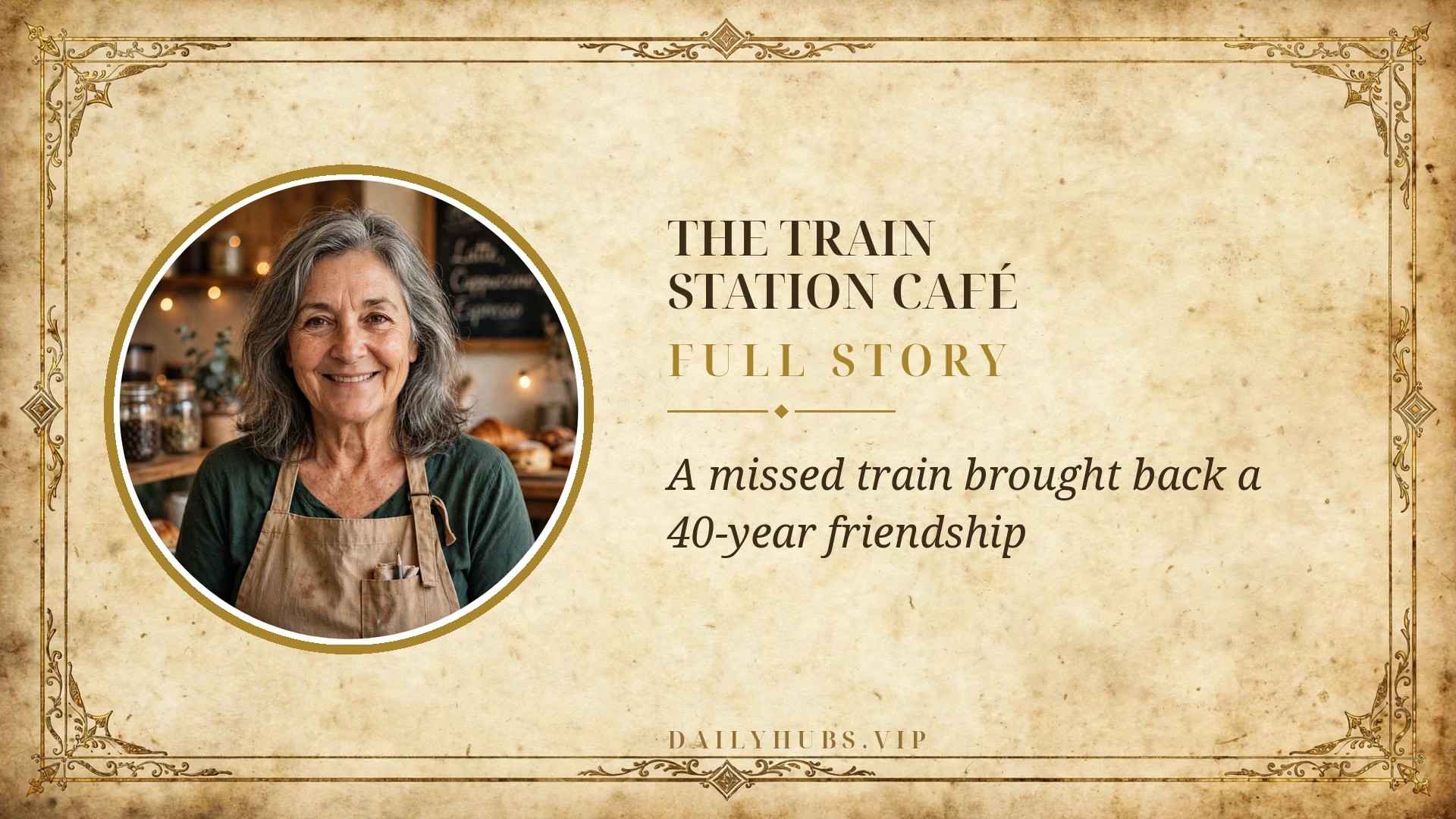
Part One: The Girl Who Missed Her Train
My name is Carol Bennett, and I am fifty-nine years old. For eleven years I have run the little café inside the Willow Junction train station, serving coffee and soup to travelers, railway workers, and the handful of regulars who treat my counter like their own kitchen table. It is not a grand place — six tables, a cracked tile floor, a window that looks out over the tracks — but it is mine, and on a rainy Thursday evening in October, it became the place where two old stories finally met.
The last train had already gone when the door opened and a girl came in, soaked through, carrying a backpack that looked too big for her. She was sixteen, maybe seventeen, with wet hair stuck to her face and a brave expression that was not quite working. She stood by the door, dripping onto my floor, and said, “Excuse me, could I just sit here until the rain stops? I don’t have money for coffee.”
“Sit,” I said, “and I will bring you soup. Rain is free, but soup is better.”
Her name was Mia. She had missed her train to the city, where she was supposed to meet a school group, and her phone had died, and she had no way to call anyone. She ate the soup the way hungry people eat — quickly, then slowly, as if she had only just remembered she was allowed to take her time. As she warmed up, she began to talk, the way lonely young people do when someone is kind to them without asking for anything back.
She told me about her grandmother, who had raised her since she was small, in a town not far from here. Her grandmother’s name was Edith. Edith Hartley. And when Mia said that name, my soup ladle stopped in mid-air.
Edith Hartley had been my best friend when we were girls. We had shared a desk at school, traded dresses, told each other everything — until we were eighteen, when a rumor went around that Edith had stolen money from the school trip fund. I had believed it. I had stopped speaking to her. She had moved away the next year, and I had never seen her again. Forty years of silence, over something I had never once checked to see if it was true.
“Your grandmother,” I said carefully, “does she ever talk about Willow Junction?”
Mia nodded. “She grew up near here. She says she had a best friend here once, but they had a falling out. She never says the friend’s name. She just gets quiet.”
I looked at this wet, brave girl eating my soup, and I understood that life had just handed me something I did not deserve and could not waste: a second chance, sitting at my table, asking for nothing but warmth.
“Mia,” I said, “I think I know your grandmother. And I think I owe her an apology that is forty years late. Will you help me make a phone call?”
