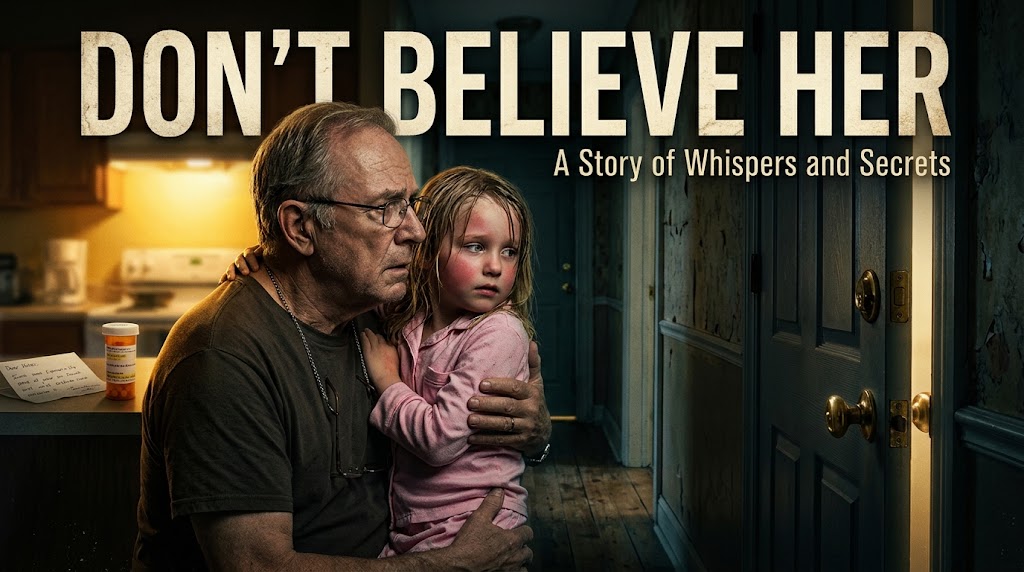
PART 3
The knob stopped.
For three seconds, maybe four, the only sound in that house was the dispatcher’s voice in my ear. “Sir? Sir, are you still with me?”
“I’m here,” I said. My voice came out like gravel. “There’s someone in the hallway closet. I think it’s my grandson.”
“Is the door locked?”
I looked at it properly for the first time. One of the kitchen chairs, the same oak set I had helped Brian assemble the summer Mason was born, was jammed under the handle, its back wedged so tightly beneath the brass that the knob could turn all it wanted and the door would never open.
Someone had done that on purpose. Someone had tilted it exactly right.
“Not locked,” I said. “Blocked.”
“Help is on the way, sir. Four minutes. Stay on the line.”
Lily stirred against my shoulder. Her breath was hot on my neck, quick and shallow, like a little bird’s. “Grandpa, don’t. Please.”
“Sweetheart, why?”
Her eyes rolled toward me, glassy and unfocused. “Because if you open it, he’s in trouble. And if he’s in trouble, the man comes.”
“What man?”
“The one from the state.” She said it the way children say the name of a monster. “Mommy said they take kids who tell. They put them in a different house and you never see your family again.”
Something cold and heavy settled into my chest.
I had been a high school shop teacher for thirty-four years. I had met a lot of frightened kids. I knew the difference between a child who feared punishment and a child who had been taught to fear rescue.
This was the second kind.
“Lily,” I said, as steadily as I could, “listen to me. Nobody is taking Mason. Nobody is taking you. I am your grandfather, and I’m not going anywhere. But your brother is in there, and he knocked, and I’m not going to leave him.”
She didn’t answer. Her head had gone heavy again.
I carried her to the living room and laid her on the couch, propped on her side the way Carol had taught me when our own kids had fevers. I pulled the afghan off the armrest and draped it over her legs, then stopped and pulled it back off, because her skin was burning and the last thing she needed was another layer.
“Stay right there, honey. Two minutes.”
I went back to the closet.
The chair came free with one hard yank. I set it aside, put my hand on the knob, and said, “Mason? Buddy? It’s Grandpa. I’m opening the door.”
No answer.
I opened it.
The closet was the deep kind, the kind people use for coats and vacuum cleaners and the boxes of Christmas decorations nobody wants to carry back to the attic. Someone had cleared the floor. In the middle of that clear space, on a folded bath towel, sat my ten-year-old grandson with his knees pulled to his chest.
He was wearing the same blue pajama shirt I’d seen him in on Sunday. His lips were cracked. His hair was stuck to his forehead with sweat, and the air that rolled out of that closet was thick, stale, and warm.
There was a plastic water bottle beside him. Empty. A bucket in the corner I decided not to look at. And on the inside of the door, at about the height of a ten-year-old’s reach, the paint had been rubbed raw in a circle, as though he had spent hours with his hands pressed there, listening.
Mason blinked up at me in the light.
Then he said the thing I will remember until the day I die.
“I didn’t tell her, Grandpa. I promise I didn’t tell. I was quiet the whole time.”
I went down on my knees on that hardwood floor, and my sixty-nine-year-old knees did not complain, and I pulled that boy into my arms.
“You didn’t do anything wrong,” I said into his hair. “Do you hear me? Nothing. Not one thing.”
He didn’t cry. That was what frightened me. He just went stiff and still, like an animal that has stopped expecting to be touched gently, and then, slowly, his arms came up and gripped my back with a strength that startled me.
Sirens turned onto the street.
The next twenty minutes passed in pieces.
I remember two paramedics, a man with a gray goatee and a young woman with her hair in a tight braid, moving through Brian’s living room as though they had done it a thousand times. I remember the woman kneeling beside Lily, saying her name softly, again and again, while the man clipped a small device to her finger and frowned at the number.
“Temp’s a hundred and four point two,” he said. “Heart rate’s way up. Skin’s flushed and dry. Pupils are huge.” He looked at his partner. “Sir, do you know what she took?”
“I don’t think she took anything,” I said. “I think somebody gave it to her.”
I took them to the kitchen and showed them the orange bottle. The woman read the label, photographed it with her phone, and said something into her radio that I couldn’t follow except for the words anticholinergic and pediatric ICU alert.
The label wasn’t Lily’s name. It wasn’t Mason’s, either. It was Marissa’s, a prescription Marissa had been given months ago for her own trouble sleeping. Next to it, on the counter, sat a bottle of children’s cough syrup with the seal broken and the cap missing.
One of them had done the math in the dark, I thought. One of them had measured out something for an eight-year-old as though she were a small adult, because it was easier than sitting up with a sick child.
I don’t know which of them. I only know I wanted to put my fist through the wall, and that I did not, because Mason was holding my hand and I could not let go of it.
The woman with the braid carried Lily out wrapped in a silver blanket. I tried to follow, and a police officer I hadn’t noticed arrive put a hand lightly on my arm.
“Mr. Hale? I’m Officer Dunning. They’re taking her to Children’s. We’ll get you there in a minute, but I need to see what you found first.”
I nodded. I couldn’t speak.
He was a tall, tired-looking man in his forties with a wedding ring and a coffee stain on his cuff, and he read my son’s note slowly, all the way to the bottom. When he reached the last line, he closed his eyes for a full second.
“Don’t believe her about the closet,” he read aloud, very quietly.
“He wrote it before she told me anything,” I said. “He wrote it knowing she’d tell me.”
“Yes, sir.” Dunning folded the paper along its original creases and slid it into an evidence bag. “That’s what makes it matter.”
He crouched in front of Mason, who sat on the arm of the couch wrapped in a jacket someone had found. “Hey, buddy. My name’s Tom. I’m not here to get anybody in trouble. Is it okay if I ask you something?”
Mason’s eyes flicked to me. I nodded.
“How long were you in the closet?”
Mason thought about it, and I watched the terrible arithmetic go across his face. “Since after dinner. Friday.”
I did the count in my head. It was now Saturday, a little past three in the morning.
Ten hours. Maybe more.
“Did you have a light in there?”
“They took the bulb out,” Mason said. “Mom said it was so I’d think about it.”
“Think about what?”
His voice dropped to a whisper. “I told Lily it wasn’t fair that she got sent to bed with the medicine. I said she was sick and Mom should take her to the doctor. Mom said I was being disrespectful and ruining my own birthday.”
Officer Dunning didn’t move a muscle. “And then?”
“And then they got ready to leave. And Dad put the chair under the door.” Mason swallowed. “He said it was just so I’d stay put till they got back. He said Grandpa would never come, because Mom told you we were all in Florida.”
I sat down on the floor, because my legs decided for me.
Children’s Hospital at four in the morning has its own kind of silence. It is not peaceful. It is a silence made of people holding their breath.
A nurse took Mason straight into an exam bay, and I followed, and when a social worker named Ms. Okafor introduced herself, Mason’s fingers locked around my wrist so hard it hurt.
“No,” he said. “No. Not her. She’s the one from the state.”
Ms. Okafor didn’t flinch. She was a small woman in her fifties with silver in her hair and reading glasses on a beaded chain, and she lowered herself onto a rolling stool until her eyes were below his.
“Mason,” she said, “I can see why that name scares you. Somebody told you a story about people like me, and I’d be scared too if I believed it. Can I tell you what I actually do?”
He said nothing.
“My whole job,” she said, “is to make sure kids are safe, and then to try to keep families together if there’s a safe way to do it. Do you know what the very first thing I do when I meet a child is?”
He shook his head.
“I ask who they want near them.”
Mason stared at her. Then, slowly, his eyes slid to me.
“Him,” he whispered. “And Lily.”
“Then that’s where we start,” said Ms. Okafor.
It was the first time that night I felt something loosen in my chest.
Dr. Patel found me in the waiting area at a quarter to six. I had been staring at a framed poster of cartoon whales for so long that I could have drawn it from memory.
“Mr. Hale, your granddaughter is going to be all right.”
I don’t know what sound I made. I know the young resident beside her looked away to give me privacy.
“She was suffering from a serious toxic reaction,” Dr. Patel went on. “The medication in that bottle was never meant for a child her size. It caused her temperature to spike and affected her heart rate and her ability to stay awake. Combined with the cough syrup, and the fever, and several hours without anyone checking on her, it could have been fatal. It very nearly was.”
“She called me,” I said stupidly. “She picked up the phone and called me.”
“Yes. And that call is the reason she’s alive.” Dr. Patel’s voice softened. “Whatever she was feeling at that moment, she was clearheaded enough to know who to trust. That is not nothing, Mr. Hale. Children who’ve been told to keep secrets often don’t.”
I covered my mouth with my hand.
“We’ll keep her for observation. Possibly two or three days. She’ll be groggy and she may not remember much of tonight.” She hesitated. “I should also tell you that the pediatrician’s records and her exam show a few things that concern us. Nothing from tonight. Older things. Ms. Okafor will want to speak with you about them.”
I looked up. “Older things?”
“Bruising. Weight lower than expected for her age. A pattern of missed appointments.” She said it gently, like laying down something fragile. “I’m not telling you what happened. I’m telling you what the chart tells me.”
Something in me understood then that the closet hadn’t been the beginning. The closet was just the night someone finally left a door where I could find it.
Lily woke at seven.
I sat at her bedside with a plastic cup of lukewarm coffee going cold in my hand, watching color return to her cheeks in slow, uneven patches. The fever had finally broken somewhere around six. Her hair, still damp, had dried into little curls against the pillow, and her hand lay on the blanket with the IV taped to the back of it, tiny and bruised at the edges.
Her eyelids fluttered. She looked at the ceiling. Then at me.
“Grandpa.”
“Hi, sweet pea.”
“Am I in trouble?”
I will never forgive myself for how that question broke something in me. I leaned forward and took her free hand in both of mine.
“No, Lily. You’re not in trouble. Not tonight, not ever. You did exactly the right thing. You called me. Do you remember?”
She frowned, searching. “I remember it was really hot. And the phone was under the couch. I had to reach.” Her voice cracked. “Mommy took my phone away. But Mason hid his old one for me last week. In case.”
“In case of what?”
She looked at the ceiling again and her lip trembled.
“In case they went away and forgot us.”
I pressed her knuckles to my forehead, because I couldn’t stand to let her see my face.
Outside the room, through the narrow window in the door, I saw Ms. Okafor talking quietly with Officer Dunning, who was nodding and writing on a small pad. When he looked up, our eyes met through the glass.
He held up a phone. His own. And then he mouthed one word.
Found.
They had found Brian and Marissa at a lakeside resort three hours north, a place with a spa, a restaurant, and a very nice view of the water. Not Florida. Not even close.
They had checked in Friday evening under Marissa’s maiden name.
“Dispatch says they were asleep when units knocked,” Dunning told me in the hallway. “Brian wasn’t. He was sitting on the edge of the bed with his phone in his hand. He had it open to your number.” He paused. “He hadn’t pressed call.”
I didn’t know what to do with that. I still don’t.
“They’ve been told what happened,” Dunning said. “Marissa lawyered up before they even left the hotel. Brian asked to come straight here.”
“I don’t want him near my granddaughter.”
“I understand, sir. Nobody’s letting him near either of the kids today. But he’s requested to speak with you.”
I almost said no. I had the word ready. It was sitting right on my tongue.
Then I thought of Carol, who had spent thirty-eight years teaching me that love is not a feeling you pull out only when things are easy. She had once said, after one of Brian’s worst teenage nights, that the day you stop being willing to hear your child out is the day you lose the right to be surprised by who he becomes.
I hated her for that thought, a little, standing in that hospital hallway.
I said, “Where?”
They put us in a family consultation room with a tissue box, a plant that was probably fake, and a painting of a lighthouse. Officer Dunning stood just outside the glass door. Ms. Okafor sat in the corner, quiet, a silent witness.
My son walked in at 9:12 a.m.
Brian is forty-one. Tall, like his mother’s side. Last Sunday he had laughed over pancakes. Now he looked as if someone had spent a year taking things out of him. His hair was uncombed, his eyes were swollen red, and his hands, which had once held my granddaughter for the very first time, shook like a leaf in wind.
He stopped three feet from the table. He didn’t sit.
“Dad.”
I said nothing.
“Dad, I—” He pressed a hand over his mouth. A sound came out of him I had not heard since he was seven, when his dog died. “I didn’t think—”
“That,” I said, very softly, “is the problem, Brian. You didn’t think.”
He sank into the chair like his strings had been cut.
For a long time, he didn’t say anything. Then, as if he had rehearsed it in the car and every sentence had come apart on the way, the words started coming out.
“It started with Lily being sick a lot. Earaches. Stomach things. And Marissa got so tired. She wasn’t sleeping, and the doctor gave her those pills, and then everything just— Everything got smaller. Every little mess became a crisis. And Mason would talk back, and Lily would cry, and I’d come home and the whole house was loud, Dad, and I just—”
“You just what?”
“I just wanted it to be quiet.”
I let that sit.
“I let her handle it,” he whispered. “I told myself she was handling it. When Lily got sick, Marissa said a little extra medicine would let her sleep it off. I should have said no. I knew. Somewhere, I knew, and I let it go because it was easier than a fight. Then Mason started getting punished in the closet, and I told myself it was just a time-out, just ten minutes. And then it was an hour. And then—”
“And then it was a night,” I said. “With the bulb out.”
He flinched as if I’d struck him.
“The note,” I said. “Why did you write it?”
“Because Marissa said you’d call the police. She said you’d take the kids. She said you always thought she wasn’t good enough for me, that you were just waiting for a reason.” His shoulders folded forward. “And I was so afraid of losing them that I wrote it. I thought if you read it and believed it, you’d stay out of it until we got back and I could fix everything.”
“Fix it how, Brian?”
He opened his mouth. And nothing came out, because there wasn’t an answer. He had known for months that something was wrong, and he had chosen to be a man who could be talked out of looking.
I stood up. My chair scraped the floor loudly in that small room.
“I’m going to tell you what happens now,” I said, and my voice did not shake, which surprised me. “You will tell the officer everything you just told me. You will not leave out the pills. You will not leave out the closet. You will not protect Marissa, and you will not protect yourself. You will give every one of those details, and you’ll let the law decide what you’ve earned.”
“Dad—”
“Because Lily and Mason are going to have to tell the same story someday, and I’d like them to learn that the grown-ups in their life can at least do that much.”
Tears slid down my son’s face and he made no attempt to wipe them.
“Will they let me see them?” he asked.
“I don’t know,” I said. “That’s not up to me anymore. And honestly? It shouldn’t be up to you either.”
I turned toward the door. Behind me, he said my name one more time, small and cracked, a little boy’s voice in a grown man’s body.
I stopped, but I didn’t turn around.
“I loved them, Dad. I swear I did.”
“I know you did,” I said. “That’s the part that makes it so hard.”
I walked out.
In the corridor, Ms. Okafor caught up to me. Officer Dunning walked a few steps behind, and for a moment all three of us stood there under the buzzing fluorescent lights, not talking.
“Mr. Hale,” she said. “The kids can’t go home. You understand that.”
“Yes.”
“There will be a hearing. Emergency placement is typically with a relative if one is willing and suitable.” She looked at me over her glasses. “Marissa’s sister has already been in touch. She’s offering. But Mason asked for you, by name, three separate times this morning. So did Lily, once she woke up.”
I thought of my quiet house, the big bedroom with half a closet still full of Carol’s sweaters. The guest room no one had slept in since the funeral. The kitchen table with room for four.
“I’m sixty-nine,” I said, as if arguing with myself. “I don’t know the first thing about—”
“You knew enough to answer the phone,” said Officer Dunning quietly.
I almost laughed. It came out as something wet and ragged instead.
“What do I need to do?”
“For starters,” Ms. Okafor said, a small smile appearing for the first time, “sleep. Then paperwork. A home visit. Background check. A great deal of paperwork.” She tilted her head. “And you’ll need to be ready for the hard days, because there will be hard days. Children who’ve been through this don’t just bounce back. They test you. They hide food in their pillowcases. They flinch when someone closes a door.”
“I can do that,” I said.
And I realized, the moment the words left my mouth, that I meant them more than anything I had ever said.
Mason found me an hour later.
He had been given clean clothes from the hospital’s donation closet: a gray sweatshirt two sizes too big, a pair of navy sweatpants rolled at the ankles. A nurse had fed him toast and apple juice. He stood in the doorway of Lily’s room, one hand wrapped around the frame, looking at me with an expression I couldn’t read.
“Grandpa?”
“Right here, buddy.”
He crossed the room slowly and stopped beside my chair. Then, without a word, he reached into the pocket of the borrowed sweatpants and pulled out a small, scuffed phone with a cracked screen. The old one. The one Lily had reached for beneath the couch.
“I need to show you something,” he said. “I wasn’t supposed to have this. But I thought maybe, if something ever happened… somebody should know it wasn’t only tonight.”
My mouth went dry.
“What’s on there, Mason?”
He looked at his sister sleeping, then back at me. His small face went very serious, in that way that makes ten-year-olds look suddenly ancient.
“Voice memos,” he said. “I started recording in the summer. Mom doesn’t know. Dad doesn’t know.” He swallowed. “There’s forty-one of them.”
He pressed the screen and held it out.
And as I took it with a hand that wouldn’t stay steady, the first recording began to play, tinny and distant and horribly familiar: Marissa’s voice, sweet as syrup, speaking to my granddaughter in a tone I had never once heard her use in front of me.
“Lily,” it said, “what do we say when Grandpa asks if everything’s fine?”
And a very small voice answered, “We say yes.”
