The Woman Behind the Counter
Part 1 — The Ten-Minute Goodbye
Nell Baxter set her alarm for 4:40 on her last morning, the way she had for thirty-eight years, and then she lay awake until 4:38 just so the alarm would not be the thing that ended it.
Ridgeway Elementary in Cedar Falls was quiet at five in the morning. Nell liked it that way. She liked the hum of the ovens warming up, the clatter of trays, the smell of yeast and butter while the sky outside the kitchen windows was still dark. She had started here in 1988, a twenty-nine-year-old widow with two small children and a cook’s wage that kept the lights on and the table set. She had stayed because the work was honest and because, somewhere along the way, the school had become the second home she had never planned on having.
On Fridays she made rolls. Not the frozen kind, not the ones from a bag. Real rolls, mixed by hand, left to rise under damp cloths while the rest of breakfast went out. The children called them "Friday rolls," and the teachers did too, and Nell had never once corrected anyone who assumed they came from a bakery somewhere in town.
This Friday was her last. Retirement, the papers called it. Thirty-eight years, and then a Friday like any other Friday, except for the cake in the staff room and the meeting at half past three.
The lunch service went the way it always went. Noise, spilled milk, a boy who traded his carrots for a pudding cup and then tried to trade them back. Nell moved along the counter the way she always had, apron tied twice, sleeves pushed up, calling the children by name when she knew them and by "sweetheart" when she did not. Lucy and Grace, her two kitchen helpers, worked the line beside her. At the end of service, Lucy hugged her so hard Nell’s ribs ached, and Grace cried into a dish towel and pretended she had something in her eye.
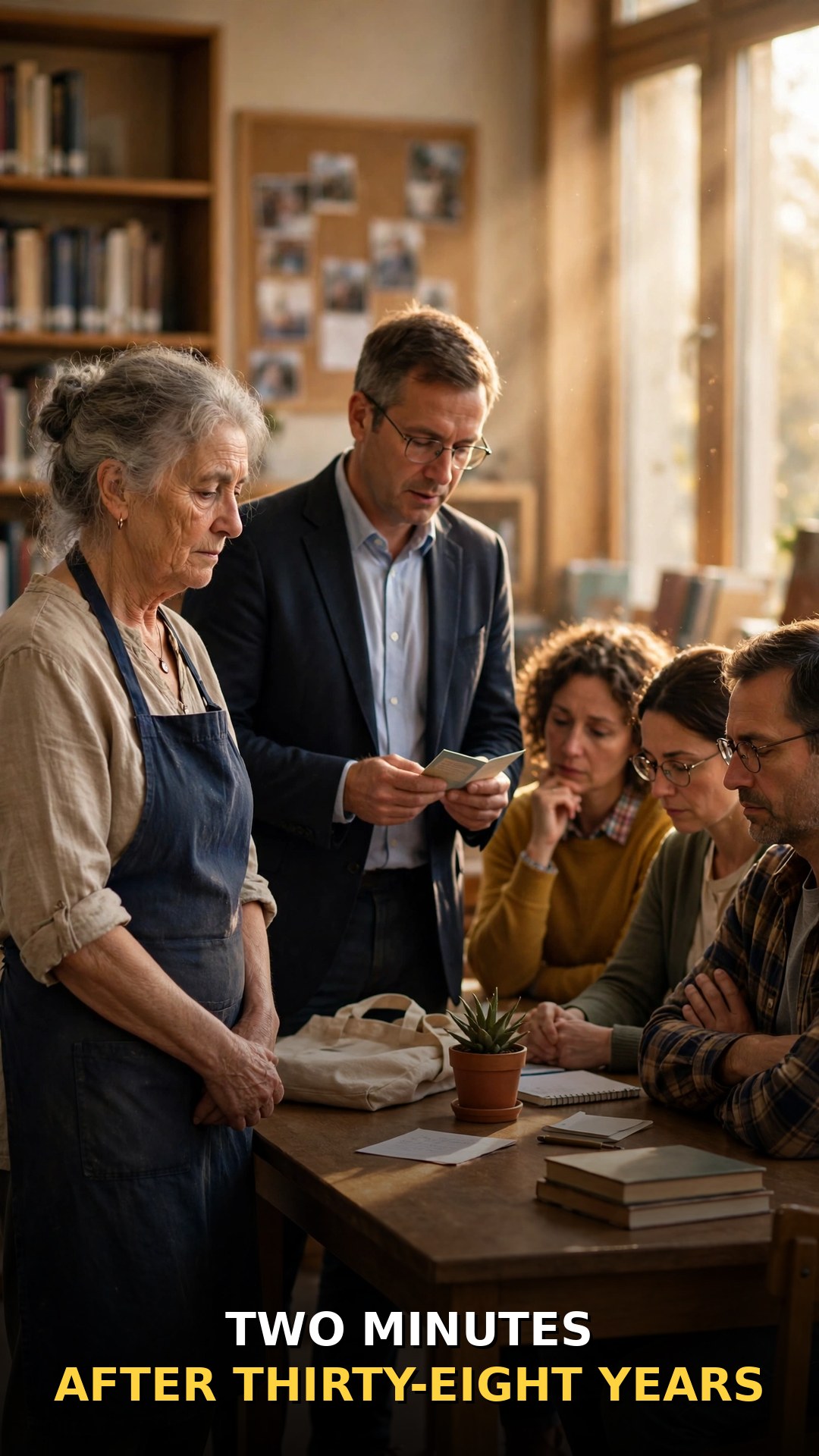
The farewell was at the end of the staff meeting, in the library, between the budget update and the announcements about the fall reading program. Principal Fitch stood up, cleared his throat, and read from a card.
"We thank Nell Baxter for her years of service to Ridgeway Elementary," he said. "Her dedication to our nutrition program has been appreciated."
Two minutes. Perhaps three. Someone had brought a cake from the grocery store, white frosting, "Happy Retirement!" written in blue icing. Someone else handed her a small potted plant in foil wrapping. There was applause, polite and brief, and then the meeting moved on to the reading program.
Nell smiled the whole time. She had practiced that smile on the drive in. She thanked everyone, she said the plant was lovely, she said she would miss them all, and every word of it was true except for the part where she was fine.
She knew how to measure what had just happened, because the same week had given her the measure. Mrs. Alden, the fourth-grade teacher, had retired on Tuesday after thirty years. Mrs. Alden had gotten the auditorium. The choir had sung. There had been a slideshow of her classroom through the decades, a plaque with her name on it, and a line of former students out the door holding flowers. Nobody had planned anything like that for the woman behind the counter. The kitchen was not that kind of place, apparently. The kitchen was the room you walked through on your way to somewhere important.
After the meeting, Nell went back to the kitchen to collect her things. Tessa Lane was already there. Tessa was twenty-nine, the new food-service director, hired from a catering company in the city to modernize the kitchen. She had a clipboard and a tape measure, and she was measuring the wall where the ovens stood, talking about workflow and throughput as if the room were a warehouse.
"We’ll streamline all of this," Tessa said, smiling brightly. "Pre-portioned, standardized. Much more efficient."
Nell nodded. She took her apron off its hook by the door — the hook where it had hung for thirty-eight years — folded it once, and set it down on the counter instead of taking it with her. She did not know why she left it there. It felt like leaving a part of herself behind to keep the room company.
She carried the potted plant out to her car, set it on the passenger seat, and sat for a moment with her hands on the wheel. She was not angry. Anger would have been simpler. She was hollowed out, the way a room feels after the furniture has been taken away and you can suddenly hear how big it is.
What she did not know, sitting in that car with a grocery-store cake still on her tongue and a plant in foil beside her, was that the school was about to find out what it had actually lost — and that the truth had started thirty-eight years earlier, with a boy, an empty tray, and a rule an old cook had whispered to her on her very first week.
