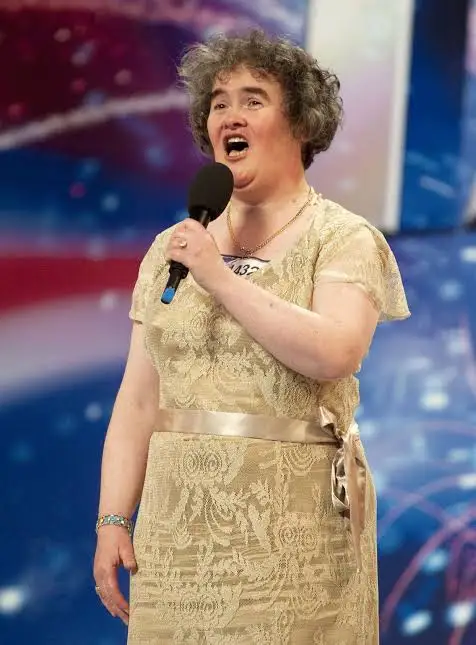
Before the music began, the room had already made up its mind.
When Susan Boyle walked onto the Britain’s Got Talent stage in 2009, the audience greeted her introduction with laughter and uncertainty. She spoke openly about a lifelong wish to sing professionally, and the reaction around the theater suggested that many people expected a light television moment rather than a serious performance.
Then the first line arrived.
Boyle chose “I Dreamed a Dream” from Les Misérables, a song built on longing, disappointment, and the hope that something better might still be possible. It demands more than volume. It needs patience, control, and a voice capable of carrying the meaning behind every phrase. Her performance had all of that from the start.
The change in the room was immediate. The same audience that had been laughing moments earlier grew quiet. The judges leaned forward. The performance did not rely on a trick, a surprise reveal, or a big production. It was simply a singer standing in the spotlight and letting a familiar song build until the entire theater understood what it was hearing.
That is part of why the audition still holds attention years later. It is not only about a strong voice. It is about the contrast between expectation and reality. Viewers can see the atmosphere shifting in real time: skeptical smiles disappear, applause begins before the song has ended, and the judges’ expressions turn from surprise to admiration.
Boyle never rushed the song. She allowed its quiet beginning to settle, then gave the higher notes space to rise naturally. By the final section, the audience was no longer waiting to see whether she could deliver. They were responding to a performance that had already changed the mood of the whole room.
The standing ovation at the end was more than a polite television response. It was an acknowledgment that everyone in the theater had judged too quickly. The moment became a reminder that talent does not always arrive with the image people expect, and that first impressions can miss the most important part of a person’s story.
Watch Susan Boyle’s full audition:
After the audition aired, the clip traveled far beyond the show’s normal audience. It was shared around the world and became one of the defining talent-show moments of its era. People who had never watched the series found it through the performance itself, often without knowing anything about the conversation that came before it.
That wider response helped turn Boyle into an international recording artist. She later released I Dreamed a Dream, which became a major success, but the audition remains the moment many people return to. The simplicity of it is still powerful: one person, one song, and a room realizing that it was wrong to underestimate her.
There are louder performances and bigger television finales, but this one lasts because the story is visible in every reaction shot. The audience begins with doubt, listens with surprise, and finishes on its feet. Long after the final note, that reversal is what people remember.
