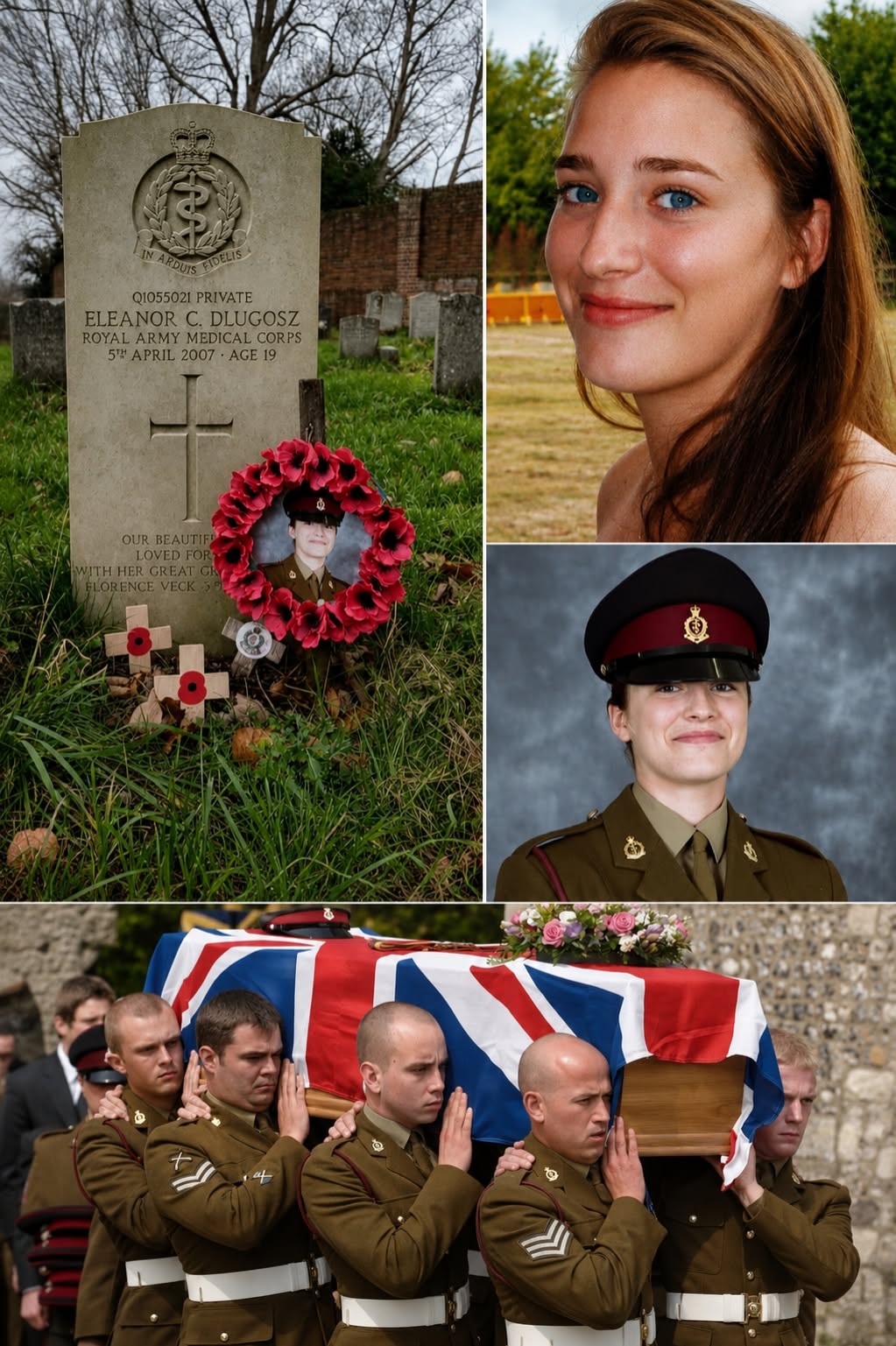
Private Eleanor Dlugosz was a teenage Army medic who chose the front line not for glory, but because she believed that was where lives could be saved.
That single choice tells you everything about her. She was only 19 when she died in Iraq, yet the shape of her life already revealed a fierce, restless purpose: to serve, to help, and to move towards danger when others would have stepped back. In the story of war, there are many kinds of courage. Hers was the quieter, harder kind — the kind that bends itself towards other people’s survival.
In 2006 and 2007, Basra was not a distant name on a map. It was a place where British soldiers lived with heat, uncertainty, and the constant threat of roadside bombs. Patrols moved through streets where every shadow could conceal danger, and every journey outside the wire carried the weight of possibility. In that landscape, a medic was not a figure at the edge of the action. A medic was often the difference between life and death. But that was only the beginning.
Eleanor Claire Dlugosz was born in Southampton in 1988 and grew up with the sort of determination that others tend to notice only after it has already taken root. Her family moved to Somerset when she was nine, and there she threw herself into life with complete conviction: Young Farmers, music, public speaking, and above all horses. She was, by every account, a girl who did not drift. She chose things, committed to them, and followed through. That difference tells you everything.
Her mother later remembered the moment the Army first caught Eleanor’s imagination. At school she attended an Army activity week, and something in that experience took hold of her completely. “I am joining the army,” she said. At first her family assumed it might pass. It did not. She went to enlist at 17 and failed the fitness test, which might have discouraged someone less stubborn, less driven. But Eleanor came back stronger, tried again, and passed. Imagine that moment: a teenager who had already decided that disappointment would not be the end of the story.
She joined the Royal Army Medical Corps and trained at Winchester, where her energy and confidence began to reveal themselves in full. Her mother later said Eleanor was “my star” and “my action girl”, and remembered that she excelled in everything she turned her hand to. One detail from those training days lingers because it captures her spirit so neatly: she was the best rifle shot, beating the boys as well as everyone else. It was not just about marksmanship. It was about the rare combination of discipline, nerve, and determination that made people remember her long after the drill ended.
By late 2006, she was in Iraq, initially providing primary healthcare at Shaibah Logistics Base near Basra. For many soldiers, that would have been enough — a demanding role in a difficult theatre, close to the violence but not always right beside it. But Eleanor wanted more. She wanted the frontline because that was where she could be most useful. So she returned to Britain in January 2007 to complete her Class 1 Medic course, the qualification that would allow her to accompany patrols and provide medical support in the thick of operations. She passed, and in March she went back to Iraq. That is what makes this story remarkable.
Now she was where she had asked to be. Attached to the 2nd Battalion, Duke of Lancaster’s Regiment Battle Group, she patrolled the streets of Basra as a frontline medic. The soldiers who served with her described a quiet young woman, shy in manner but fearless in action, a medic who never made a spectacle of herself yet earned deep respect. Her troop commander called her “a strong and morally courageous young woman”, an example to older and more experienced soldiers. Another officer said she wanted to make a difference. Eleanor was not trying to become larger than life. She was trying to be useful.
Her friends saw the same thing, but in warmer, more personal colours. To them she was “Ella” or “DZ”, the girl with the cheeky smile, the horse-loving, people-first friend who brightened a room without asking for attention. One friend remembered that helping others before herself was simply who she was. Another said she befriended everyone she met and that horses were one of her great passions. In the army, where toughness is often mistaken for hardness, Eleanor seems to have offered something rarer: steadiness without coldness, bravery without boasting.
Then came 5 April 2007. In the early hours, a Warrior armoured vehicle carrying a patrol moved west of Basra. Eleanor was inside, doing the work she had trained for, ready to treat the wounded if the worst happened. What happened next would change everything. An improvised explosive device detonated beneath the vehicle, tearing into the road and turning the patrol into a scene of catastrophic violence. In a single instant, lives were shattered. Private Eleanor Dlugosz was killed, along with Second Lieutenant Joanna Yorke Dyer, Corporal Kris O’Neill, Kingsman Adam James Smith, and a local interpreter. A fifth soldier survived but was badly injured.
The numbers are plain enough, but the human reality behind them is not. Imagine that moment: the shock of the blast, the smoke, the steel, the sudden silence after the explosion has done its work. Eleanor was just 19. She had gone back to Iraq after training, fully aware of the danger, because she believed the front line was where her skills mattered most. Her mother later said she knew Eleanor understood the risk; she had seen death around her and still chose to return. Eleanor had also quietly prepared her family for the possibility of her own death, telling her mother that when she died, everything would be easy to sort out. There is no melodrama in that. Only bravery stripped down to its bones.
The brutality of her death was matched by the scale of the grief that followed. She was buried at St Peter’s Church in Bishops Waltham, and her family and comrades gathered to honour a life that had been cut brutally short. Her funeral became a place not only of mourning, but of witness — to the girl she had been, and to the soldier she had become. Her mother’s grief was shaped by love as much as loss. She remembered Eleanor as the daughter who loved her job, loved being active, and loved horses; the young woman who had thrown herself into life with absolute intent.
Historical significance is often explained in terms of strategy, policy, and consequence, but sometimes history is changed by the moral example of a single person. Eleanor’s life did not alter the outcome of the war in a grand, sweeping sense. Yet it did something smaller and, in its own way, just as important. It reminded people what service can look like when it is stripped of ceremony: young, human, disciplined, vulnerable, and deeply committed to others. Her story sits among those of the British service personnel killed in Iraq, part of a wider generation that carried the burden of a brutal conflict into daily life, families, memorials, and public memory.
Her story still matters because it asks something of us. It asks us to look beyond slogans about courage and actually see what courage costs. It asks us to understand that sacrifice is rarely abstract to the people who make it. Eleanor was not a symbol when she was alive. She was a daughter, a friend, a horsewoman, a medic, a soldier. She wanted to help. She wanted to be where she was needed. And she went there anyway, knowing exactly what might happen. That is the terrible and luminous truth at the centre of her life.
And so her legacy endures in the most human way possible: through memory. Through the people who knew her as Ella and DZ. Through the family who still speak of her as their star. Through the quiet graveside and the war memorial and the names spoken each year on Remembrance Day. She was young, but she was not unformed. She had already become someone rare — a person who understood fear and chose duty anyway. Private Eleanor Dlugosz did not live long, but she lived deliberately, bravely, and in service of others. In that choice, made so young and carried so far, her story becomes unforgettable.
