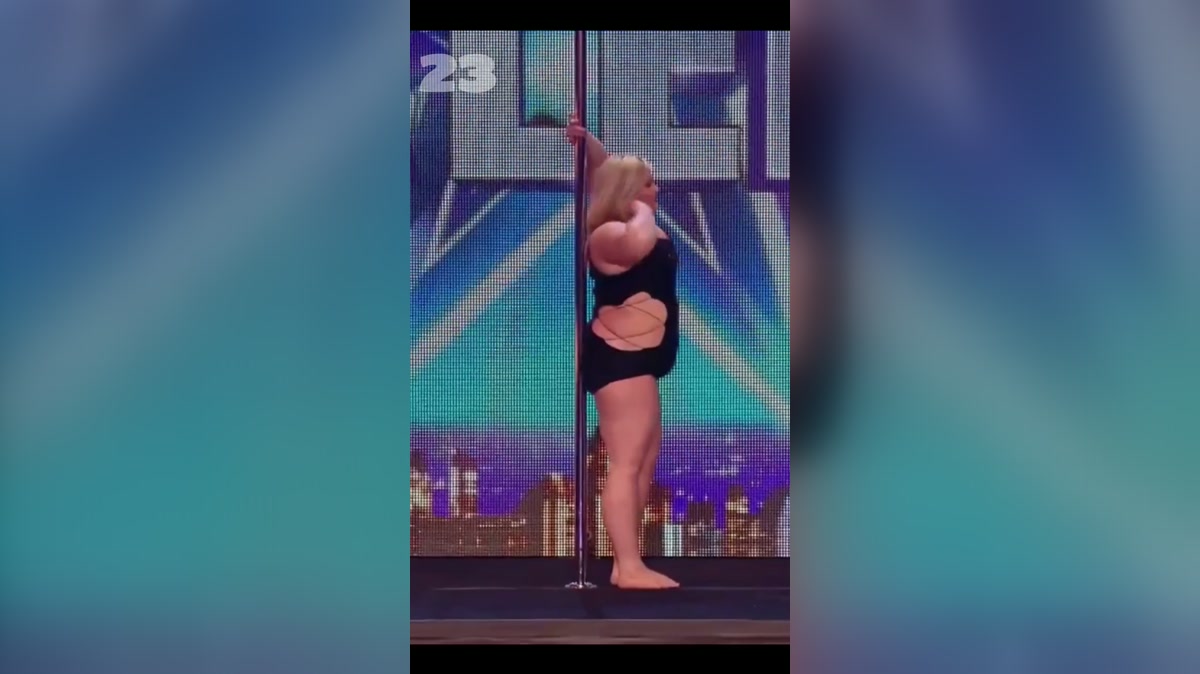
When Emma Haslam introduced herself on Britain’s Got Talent in 2014, she knew the audience might arrive with assumptions. Pole fitness is an athletic discipline often presented through one narrow body type, and the 27-year-old performer did not match the stereotype television viewers expected. Her answer was not a speech before the routine. It was to step onto the stage, take control of the pole, and let the movement make the argument.
Her audition to Katy Perry’s “Firework” became memorable for two connected reasons: the physical work in the routine and the confidence with which she refused to apologize for being there.
The routine was built around accessible strength
Emma’s performance was not designed as an elite competition routine full of uninterrupted aerial tricks. She mixed spins, holds, transitions, and floor movement in a way that made the act readable to a general television audience. That mattered. Viewers could see the strength required to control momentum around the pole, but they could also follow her personality and musical timing.
The most effective moments came when she committed fully to a transition. Pole work exposes hesitation quickly: a performer who second-guesses a grip or a turn loses the clean line of the movement. Emma’s routine was not technically flawless, yet she continued through each phrase with the energy of someone who wanted the room to enjoy the act with her.
Body confidence became part of the performance
The audition’s wider impact came from context. On television, larger performers are too often invited to be comic surprises or transformation stories. Emma presented herself as neither. She was a dancer demonstrating something she had trained to do, and the positive message grew out of that straightforward framing.
ITV later highlighted her view that size should not decide who gets to participate. Emma explained that she had long been interested in dance and acrobatics, bought a pole, and learned through home practice. Amanda Holden praised the example her confidence could set for women watching. That exchange helped the routine travel beyond the show because people recognized a familiar barrier: many never try an activity they would enjoy because they believe they do not look like the person who is “supposed” to do it.
Why the judges’ reaction mattered
The panel did not treat the act as a novelty and then move on. Their feedback focused on her nerve, the surprise of the routine, and the confidence behind it. Emma received four yes votes and advanced from the audition round. She was not ultimately selected for the live semi-finals, but the audition had already found its audience.
That distinction is important. Talent shows are competitions, yet the moments people remember are not always produced by finalists. Emma’s performance lasted only a few minutes and did not win the series. It did, however, give viewers a clear image of someone challenging a limitation that often exists only because culture repeats it.
A more useful way to read the clip
The easy headline is that the judges were shocked by a plus-size pole dancer. The more interesting story is what happened after the surprise. Emma did not ask for approval before beginning, and she did not allow the audience’s initial expectations to define the tone. She made the act celebratory.
Her audition is therefore less about proving that one particular body can perform one particular trick and more about permission. Training can begin before confidence is perfect. Confidence can grow from doing the work. And a person does not need to wait for television, fashion, or other people to decide that they look ready.
Watch the full audition
Sources
- ITV: Emma Haslam on pole dancing and body confidence
- ITV: Emma Haslam performance coverage
- Britain’s Got Talent: full audition video
Analysis based on the supplied video excerpt and the full performance and reporting linked above.
