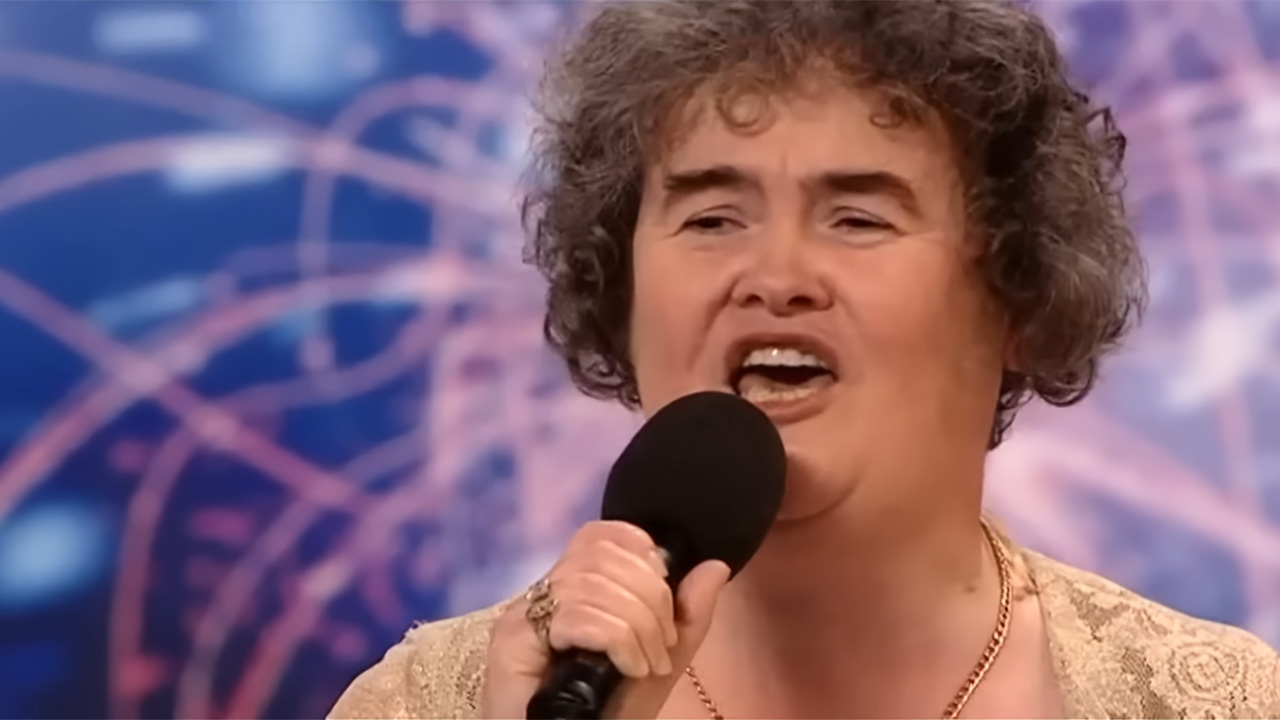
There are talent-show auditions that surprise an audience, and then there are auditions that expose how quickly an audience thinks it already knows someone. Susan Boyle’s 2009 Britain’s Got Talent appearance belongs to the second category. Before she sang a single note, the room had built a story about her. By the time she finished “I Dreamed a Dream,” that story had collapsed in public.
Boyle was 47 when she walked onto the Glasgow stage. She came from Blackburn in West Lothian, had spent years caring for her mother, and arrived with the calm, slightly playful manner of someone who had not been trained to perform confidence for television. When the judges asked about her ambitions, she named Elaine Paige as the kind of singer she hoped to emulate. The answer was sincere, but the reaction around her was skeptical. The cameras lingered on smiles, raised eyebrows, and audience members who appeared ready for a joke.
The audition began before the music
The most important part of the clip is not the first note. It is the minute before it. Boyle’s introduction creates a social test: will the audience listen to her actual goal, or will it judge the way she looks, speaks, and carries herself? The show’s editing emphasizes that tension, but Boyle’s own behavior makes the contrast sharper. She jokes about never having been married or kissed, gives a small wiggle, and waits for the room to decide what kind of person she is.
That framing explains why the opening of the song lands so forcefully. Viewers are not only hearing a singer; they are watching a prediction fail. The surprise is emotional because the audience has been invited to participate in the original assumption. When the first line arrives with control and weight, the room is forced to replace an impression with evidence.
Why “I Dreamed a Dream” was the right risk
Boyle chose “I Dreamed a Dream” from Les Misérables, a song that cannot be carried by volume alone. It asks for a clear narrative arc: restraint at the beginning, rising urgency through the middle, and a final release that feels earned rather than shouted. It is also a song about hope being damaged by reality, which gives the performance an unusual layer of self-awareness. The lyrics describe a dream that did not survive contact with the world; Boyle’s audition turns that idea inside out by showing a dream surviving precisely because the world had underestimated it.
Her opening is effective because she does not rush to prove herself. The tone is centered, the words remain intelligible, and the melody is allowed to gather momentum. Instead of decorating every phrase, she saves her most forceful sound for the places where the story needs it. That restraint makes the climactic notes feel larger. The performance does not ask the judges to admire technical difficulty first. It asks them to follow a feeling, then rewards them with vocal power.
The room changes in stages
One reason the moment remains so watchable is that the reaction does not flip all at once. It moves through several visible stages. First comes curiosity: the audience stops laughing and starts listening. Then comes recognition: the judges realize the voice is not a brief trick but a fully formed performance. Finally comes surrender: applause breaks through before the song is finished, and the people who looked uncertain at the beginning are now helping create the ovation.
Amanda Holden’s astonishment, Piers Morgan’s raised eyebrows, and Simon Cowell’s growing smile function almost like a second commentary track. The judges are not explaining the song; their faces are showing viewers how quickly their expectations have been revised. That is why the clip works even for people who already know the ending. The pleasure is in watching certainty disappear in real time.
The small curtsy is part of the story
After the final phrase, Boyle gives a modest curtsy and begins to leave. The gesture matters because it keeps the performance from turning into a victory lap. She does not behave as if she has defeated the room; she behaves as if she has completed the thing she came to do. The judges calling her back makes the ovation feel even more consequential. For a few seconds, the person who was treated like a possible punchline is the one deciding when the moment is over.
That humility is also part of why the clip traveled so far online. A viral video needs a clear emotional turn, but it also needs a person viewers want to keep watching after the turn. Boyle’s performance offers both: the shock of the voice and the warmth of someone who seems genuinely surprised that the room has finally caught up with her.
From television surprise to global story
The audition aired in 2009, when online video was already becoming a second broadcast system. Viewers could replay the transformation, send it to friends, and watch reactions outside the original program. The clip became more than a segment from a competition. It became a compact story about public judgment, delayed recognition, and the possibility that a person’s most important evidence may arrive after everyone else has made up their mind.
Boyle ultimately finished as runner-up to dance group Diversity, but the result did not define the larger cultural impact of the audition. Her debut album, I Dreamed a Dream, turned the song from a television performance into the beginning of a recording career. Sony Music describes the album as a major international success, and the official charts preserve the scale of the moment. The career that followed did not erase the awkwardness of the introduction; it made that awkwardness part of the contrast.
Why the audition still feels relevant
Modern viewers have seen countless “surprise audition” videos, so novelty alone cannot explain why this one continues to circulate. Its durability comes from the precision of the reversal. The clip does not say that appearances never matter; it shows how unreliable they become when they are treated as conclusions. Boyle is not presented as an empty mystery who suddenly discovers a voice. She is a prepared singer whose ability was present before the room decided to pay attention.
That distinction makes the moment more generous than a simple “never judge a book by its cover” lesson. The audience is not merely scolded. It is given a chance to change its mind, and the performance makes that change visible. The judges’ reactions, the crowd’s applause, and Boyle’s composed finish all become evidence of a social correction happening in public.
Watch Susan Boyle’s full audition
Sources
- Britain’s Got Talent: Susan Boyle’s first audition
- Official Britain’s Got Talent performance video
- Sony Music: Susan Boyle biography
- Official Charts: Susan Boyle chart history
This is an original analytical rewrite based on the supplied article and the linked official performance and reference sources.
