Chapter 4 — The Ice Storm
The storm came in the second week of February, eighteen hours ahead of forecast.
Marcus was in Kestrel Falls when it started, which was an accident of scheduling: a site visit with a county engineer about the condemnation notice, because he had discovered — to his own surprise — that he was willing to spend a Tuesday on a building nobody wanted. The engineer left at three. By four the rain was freezing on contact. By five the radio was reading off closures in the flat voice they use when the list is long.
He got twelve miles down Route 9 before the road stopped being a road.
What happened next happened fast and stupidly, the way it does: a plow coming the other way, a fishtail, a correction he did not have the road surface to make, and then the sedan going backward down an embankment into a drainage cut with a sound like a dropped filing cabinet. The airbag went. The windshield starred. When Marcus’s hearing came back, the car was nose-up in a ditch, the rear wheels were in eight inches of moving water, and his door would not open more than four inches because of the bank.
No cell signal. Twenty-nine degrees, dropping. Two vehicles passed in the first forty minutes, both plows, neither of which could have stopped on that grade if they had wanted to.
He was there for two hours and ten minutes, and toward the end of it he stopped being frightened and started being sleepy, which frightened him more.
The headlights that finally came down the shoulder were set high and wide, and one of them was aimed slightly wrong.
Elias Warren came down the bank sideways, on his heels, in a canvas coat, with a tow strap over one shoulder and a flashlight in his teeth. He was sixty-eight years old and he had the surefootedness of a man who has spent his life on bad surfaces.
He put the light on Marcus’s face. “Can you move your feet?”
“Yes.”
“Neck?”
“Fine. Door’s stuck.”
“Then we’re going out the other one.” Elias reached in through the four-inch gap, cut the seatbelt with a knife rather than argue with the buckle, and went around. The passenger door came open on the third pull and a rain of glass.
Getting up the bank took eleven minutes for forty feet. Elias went first with the strap, made it fast around a fence post, and came back down. The last six feet Marcus could not do with his legs, and so they did it with the strap and the old man’s shoulder and a language of grunts.
The pickup’s heater worked. That was the detail Marcus remembered for the rest of his life: the blue truck with a cracked tailgate light had a heater that put out like a furnace, and there was an army blanket behind the seat, and a second thermos, full, in the footwell.
“How did you know,” Marcus said, when his jaw worked again.
“County called me about the gate. Said a fella in a rental had been out at the Works and left at three.” Elias put the truck in gear. “Three o’clock and Route 9 and that storm is arithmetic.”
“You drove into an ice storm for me.”
“I drove into an ice storm on a road I’ve driven for fifty years,” Elias said. “Don’t upholster it.”
They went eleven miles at fifteen miles an hour with the wipers losing. Marcus sat with the blanket around him and watched the old man’s hands on the wheel — knuckles thickened, one nail permanently black from something that had happened decades ago — and said the thing he had been carrying since the garage.
“I told you to get rid of my coffee cup.”
“You did.”
“And when my car went off the road, you’re the one who came.”
Elias kept his eyes on the crown of the road. “Those two facts aren’t in a relationship,” he said. “You keep trying to put them in one.”
“They’re in one for me.”
“Fine.” The old man shifted down for the grade. “Then here’s the part you can use. I didn’t come because you’ve been loading trucks on Wednesdays. I’d have come for the plow driver. I’d have come for a man I’d thrown out of my own building.” He glanced over for the first time. “The whole trick, Marcus, is to get to where what you do doesn’t depend on what the other fella did. Everything else is bookkeeping.”
They got to the volunteer fire hall at 9:40. A paramedic looked Marcus over, gave him the news about his ribs and the good news about everything else, and asked who to call.
Marcus looked across the bay at a sixty-eight-year-old man standing by a faded pickup, drinking coffee out of a thermos cap, waiting to drive ninety-two miles home in the dark so he could load a truck at five.
“Nobody,” he said. “He already came.”
—
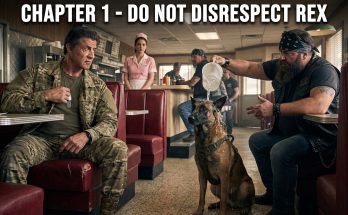
He Humiliated a Veteran’s Dog. The Same Water Pitcher Became His Second Chance.