Part 4 — "Counsel, I Was Present"
The courtroom looked smaller the second time.
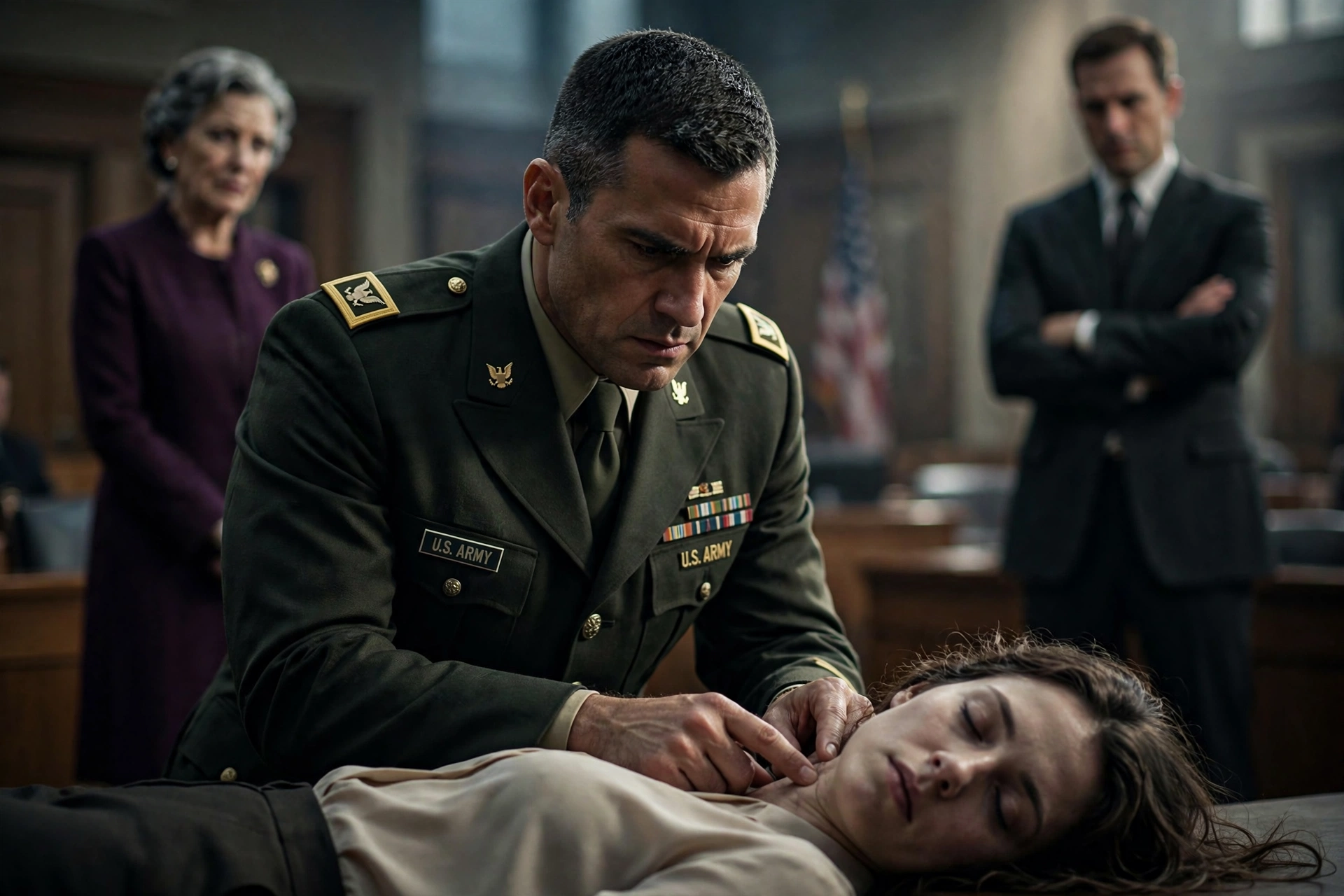
Nathan was already seated beside his lawyer. Diane was in the gallery behind them, in the same seat as before. And near the aisle, in a plain dark suit this time, sat Colonel David Mercer — the stranger whose two fingers on my neck had changed the course of my daughter’s life.
Judge Briggs confirmed I was medically cleared to proceed. Then Nathan’s lawyer rose and, in the smooth voice of a man stepping around something on the pavement, said his side had never intended to suggest my newly diagnosed heart condition was fabricated.
Judge Briggs took off his glasses.
"Counsel," he said, "I was present."
He did not raise his voice. He did not need to. Something in the room rearranged itself around those four words, and for the first time, the confidence on Nathan’s side of the aisle looked like what it was: an act, performed by people who had expected never to be contradicted.
Colonel Mercer was called first. Nathan’s lawyer tried to shrink him — the colonel had never been my doctor, had he? Had never treated me before that day? Mercer agreed to all of it pleasantly. He could only testify to what he personally observed. Then he added, in the same even tone: "I observed a woman in the middle of a genuine medical emergency, while the people closest to her told the room she was pretending."
Nathan did not look at him again.
When my turn came, I asked the colonel three questions. Had we ever met before that morning? No. Could I have known he would be in that courtroom? No. And could a person simply decide to slow her own heart to thirty-six beats a minute? He turned slightly toward the bench. "Not by deciding to, Your Honor."
Then came the May record. Judge Briggs read the recommendation aloud himself — the heart monitor, the words cannot be ruled out — and asked Nathan’s lawyer, mildly, whether that document had been available to his side before the first hearing. There was a pause you could have driven through. "It had, Your Honor." The judge nodded slowly and observed that there was no final diagnosis yet and there was no reason to suspect a physical cause were not the same sentence, and his courtroom was not the place to pretend otherwise.
Nathan testified that he had never meant to mislead anyone. He had truly believed my symptoms were anxiety — that was simply how they looked to him. So I showed him his own message, sent the night I lay in a cardiac ward: "Your stunt has now delayed everything." He said he had been angry. I asked him what exactly he had been angry about — that the hearing was delayed, or that I had collapsed in front of witnesses who could not be managed? He had no clean answer. The room heard the absence of one.
Then I asked the question I had carried out of that courtroom on a stretcher. "Nathan. When I fell — when I was lying on the floor and a stranger had to run to me — why didn’t you come?"
His lawyer objected. Judge Briggs allowed it.
Nathan looked at the table for a long time. "I thought you were doing what you always do," he said at last. "Making things bigger than they are."
Diane’s testimony nearly undid her son’s whole case, because she tried to renovate it. She had never said I was faking, she explained — only that I exaggerated. I asked her what medical training she had. None. Whether she had ever read my complete records. She had not. How, then, she had known — before I even hit the floor — that nothing was wrong with me. She looked toward Nathan, and then she gave me the truest sentence she has ever spoken:
"I knew her."
There it was. She had never needed evidence, because she had decided who I was years ago, and every symptom since had been filtered through that decision until nothing I said could possibly count as true. I sat down, and I let the silence after her words do work that no argument of mine ever could.
Laura Finch testified last. Grace loved both her parents, she said, and needed both of us — and then she described a seven-year-old who believed it was her job to monitor her mother’s body and judge her honesty, who had been handed adult contempt in a grandmother’s voice and told to carry it. Nathan’s problem, Laura said, was not whether he could feed or house or love his daughter. It was whether he could keep his war with me out of her small hands.
Judge Briggs listened to all of it without interrupting once. Then he announced a recess before he issued temporary orders.
Outside, in the corridor, Nathan came up to me. "You made me look terrible in there."
I said, "I asked questions. The answers did the rest."
The bailiff opened the doors and called us back in. Nathan walked to his table. Diane sat down behind him. I returned to the same spot where, weeks earlier, I had needed a railing just to remain standing — and I stood there, steady, on my own two feet, with my heart ticking evenly in my chest like a small, faithful machine.
Judge Briggs entered with several pages of handwritten notes. He sat. He looked at Nathan for a long moment, and then at me. And then he began to speak.
