Part 5 — The Ruling
Judge Briggs did not read his ruling like a man in a hurry.
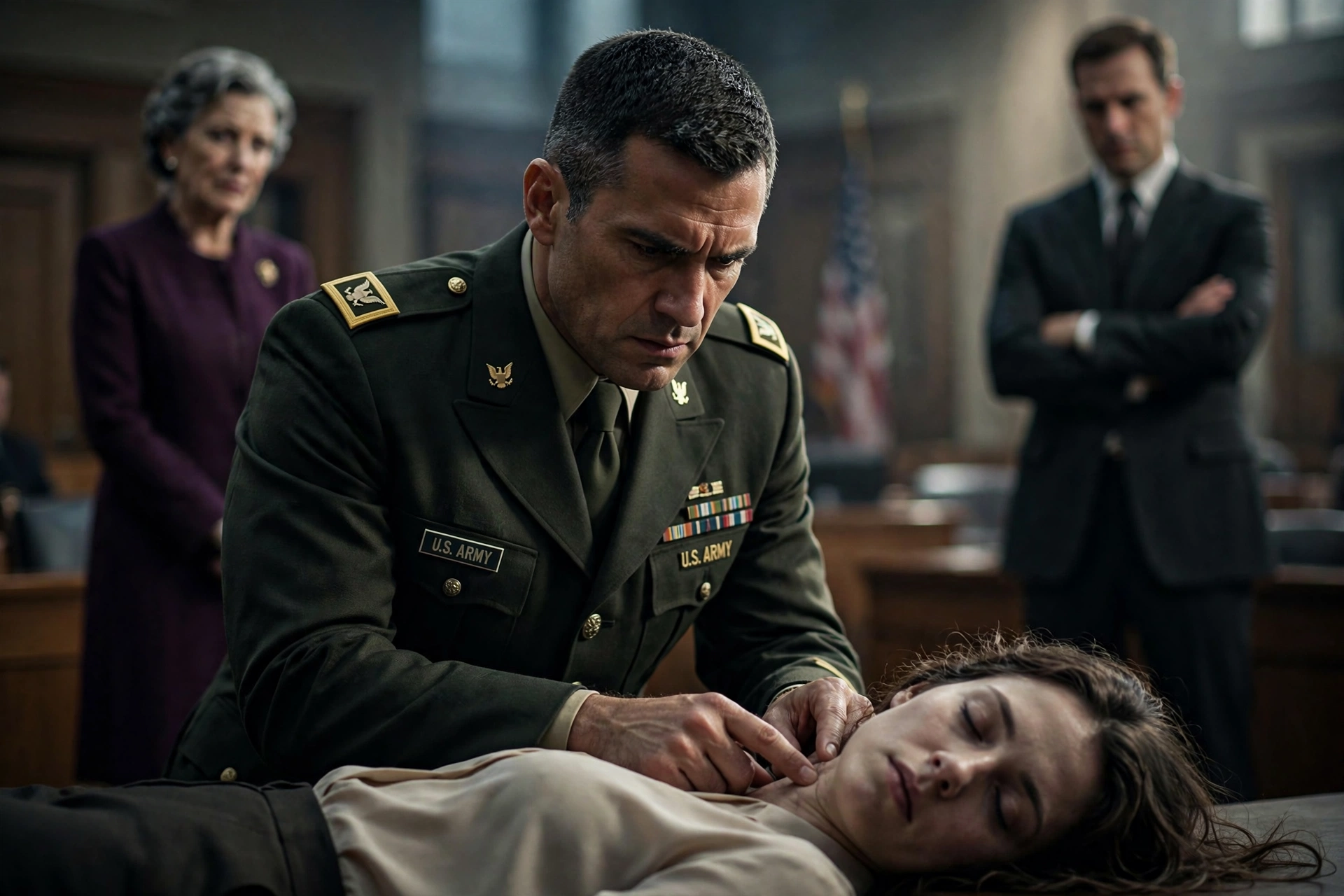
He began with the facts, laid end to end the way I had laid them in my kitchen at midnight. A year of symptoms. A medical recommendation, made in May, in the father’s presence, for monitoring that never happened. A filing that described a documented medical question as a mother’s invention. A collapse in his courtroom, witnessed by an Army physician, with a recorded heart rate of thirty-six beats per minute. A diagnosis. A device now keeping rhythm in my chest. And threading through all of it, a seven-year-old girl who had been taught to watch her mother for signs of lying.
"Custody," the judge said, "is not a prize for the parent who argues best. It is an arrangement for a child. And this court will not build an arrangement on a story that had to be edited to be believed."
The temporary orders were these.
Grace would live primarily with me while I completed my cardiac follow-up. Nathan would have her every other weekend and one evening a week — real time, generous time, because Grace loves her father and this court, the judge said, does not punish a child for her parents’ war.
But there were conditions, and he read them slowly.
Neither parent would discuss the case, the other parent’s health, or the other parent’s honesty with Grace — ever, at all, in any form that reached her ears. Grace was never again to be asked, by anyone, whether her mother "seemed sick" or "seemed fine." She was a child, not an instrument.
Both of us would complete a co-parenting program within ninety days. Nathan would attend counseling of his own, and the court would review his progress at the next hearing.
And Diane — the judge turned, at last, to the gallery — would have no unsupervised contact with Grace until she had completed the same parenting program and demonstrated, to the guardian ad litem’s satisfaction, that she understood why a grandmother’s contempt becomes a child’s burden. "Grandparents are a gift in a child’s life," Judge Briggs said. "They are not a second front in a war."
I had braced myself for years to be either rescued or destroyed in a courtroom. Nobody warned me what it would feel like to simply be believed, in full sentences, by a man with a gavel. I sat very still with my hands folded so that nobody would see them shaking — not from my heart this time. From relief, which turns out to have its own weather.
Nathan did not appeal. Outside the courtroom, with his lawyer already walking away, he stopped beside me and looked at the floor and said the closest thing to an apology I may ever get from him: "I really did think—" He ran out of road. "I don’t know what I thought."
I said the kindest true thing I could find. "Grace needs her dad. Be the version she already believes in."
It has been four months since the ruling. The pacemaker and I have become unremarkable to each other, which is the great miracle of it — I climb stairs, I carry laundry, I chase a seven-year-old around a playground, and I do not think about my heartbeat at all. Nathan finished his program two weeks early. He is not a different man, but he is a more careful one, and careful, I have learned, is where different starts.
Diane completed her classes. Her first supervised visit, she brought Grace a small wooden horse she had painted herself, and she did not say one word about me in either direction. It is a beginning. Beginnings are allowed to be small.
Last week, Grace asked me out of nowhere whether the "battery heart" would need new batteries someday, and whether it would hurt, and whether she could be there. I told her doctors handle all of that, and her only job — now and always — is to be seven.
She considered this with enormous seriousness. Then she said, "Okay. But I knew you weren’t pretending," the way other children say the sky is blue, and went back to her horses.
People ask me sometimes what finally won my case, expecting a dramatic answer — the colonel, the collapse, the four words in open court. Those things mattered. But that is not the truth of it.
I did not win because I finally performed well enough to be believed.
I won because, for the first time, all the pieces of my story were allowed into the same room, in their proper order, at the same time — the symptoms and the May note and the messages and the monitor and my daughter’s small frightened voice. My story had never been empty. It had been edited.
If you are living inside a story someone else keeps trimming down to make you look like the problem — keep your records. Save the messages. Write the dates. And get your ending in full, in order, in front of someone whose job is the truth.
It worked for the woman they called a liar in open court.
It can work for you.
— THE END —
Thank you for reading "She Wasn’t Pretending." More true-to-the-heart stories every week at dailyhubs.vip.
