She Wasn’t Drunk
Part 1 — "There She Goes Again"
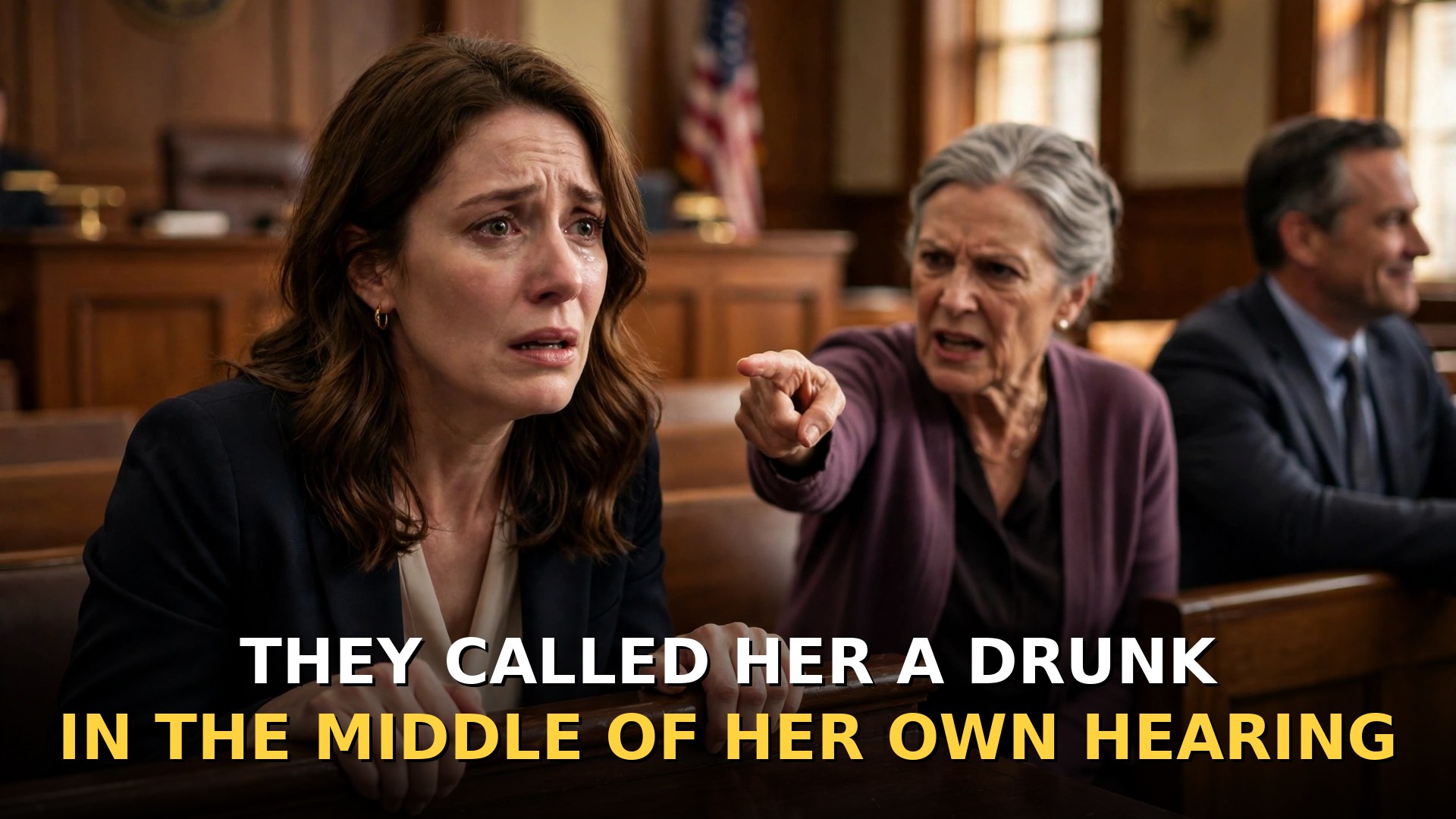
My mother-in-law stood up in the middle of my custody hearing, pointed at me with a hand that did not shake at all, and said, "Your Honor, she’s drunk right now. Look at her. She’s always drunk."
My husband Mark did not even look up from the table. He just smiled the small, tired smile he had been practicing for months — the smile that said you see what I live with — and sixty seconds later the bailiff caught me before my head hit the courtroom floor.
I teach third grade. I have taught third grade for eleven years, in the same classroom, with the same alphabet border over the whiteboard. I have never in my life had a drinking problem. What I had, that morning, was a taste in my mouth like old pennies, hands that would not stop trembling, and a room that kept sliding gently to the left no matter how hard I stared at the judge’s nameplate.
Judge Alvarez leaned forward. "Mrs. Brooks, are you able to continue?"
I had prepared for that question all weekend. I had written my answer on index cards. I teach nine-year-olds to use their words when the words are hard, and I had promised myself I would use mine: that my son Tommy had started flinching at pickup time, that he had begun carrying his little backpack to the door of his father’s house like a shield, that something in him had gone quiet in a way no nine-year-old should be quiet. I opened my mouth to say it, and the sentence came out in the wrong order, soft at the edges, like a song played through water.
Mark’s lawyer rose, almost gently. "Your Honor, this is what we’ve been describing. The slurring. The episodes. The school has documented—"
"I am not—" I said, and the word drunk would not come. My tongue felt too big for my mouth. Somewhere behind me, in the gallery, I heard my mother-in-law say the thing she had been saying at church, at Thanksgiving, at the school gate, for a year: "There she goes again."
The floor did not rush up the way it does in films. It simply stopped being where I had left it. I reached for the edge of the table and found the bailiff’s forearm instead — solid as a banister — and a voice close to my ear said, "I’ve got you. Sit down right here, ma’am. Sit down for me."
His name was Daniel Reyes. He had been a paramedic for nine years before he took the bailiff’s job, and he told the room so later, under oath, in the same even voice he used on me. That morning he just eased me into a chair, and then he did the three things nobody else in that room thought to do. He leaned close — not to help me save face, but to smell my breath. He looked at my hands, shaking like leaves. And he said, loud enough for the whole courtroom to hear:
"There’s no alcohol on her. None. This isn’t drink — this is a crash. Somebody get me the first-aid kit and call an ambulance. Now."
Ruth laughed. Actually laughed, one short note. "She fools everyone," she said. "That’s the whole problem. She fools everyone."
Reyes did not answer her. The first-aid kit had a glucose meter in it — the judge’s clerk was diabetic, though I only learned that later — and Reyes pricked my finger with hands so steady I remember thinking he must have done it ten thousand times. He read the little screen twice. Then he turned it around so Judge Alvarez could see it herself.
"Thirty-eight," he said. "Her blood sugar is thirty-eight. A sober woman, a drunk woman — nobody fakes a number, Your Honor."
The paramedics gave me glucose gel and then a dextrose drip, and my hands stopped shaking in the ambulance like somebody had switched something back on. Judge Alvarez suspended the hearing before I was even fully out of the room, and I remember the last thing I saw was Mark, standing now, saying "She’s — wait, she’s actually—" to nobody in particular.
And Ruth, gathering her purse with great dignity, telling the woman beside her: "Well. She certainly knows how to make an entrance."
What the hospital found that night is why I will never again apologize for my own body.
