Part 5 — The Ruling
[Website only — the finale]
Judge Alvarez did not waste a word, and I have thought since that a good ruling is like a good lesson: every sentence earns its place.
She began with the facts, in order, the way I had laid them on my kitchen table. A year of episodes. A school nurse’s report with a number in it — 44 — that had been read around rather than read. An urgent-care recommendation, made in April, in the father’s presence, for a work-up that never happened. A filing that used the word "drunk" eleven times about a woman whose problem was that her pancreas was dying by inches. A glucose of thirty-eight in her own courtroom, taken by an officer of that court, while the child’s grandmother called it theater. A diagnosis. And running underneath all of it, like a ground note, a nine-year-old boy collecting his mother’s medicine into his backpack because the adults had made her body his assignment.
"A custody case," Judge Alvarez said, "is not a referendum on a family’s reputation. It is an arrangement for a child. And this court will not build an arrangement on an accusation that dissolved the first time anyone in this room bothered to measure it."
The temporary orders were these.
Tommy would live primarily with me, on my treatment plan, with the school nurse looped in — a plan the court described as "already functioning," which remains the nicest thing anyone in a robe has ever said about my kitchen-table logistics. Mark would have him alternate weekends and Wednesday evenings — real time, generous time, because Tommy loves his father and, the judge said, this court does not punish a child for the education his father still needs.
But there were conditions, and she read them at the speed of a woman setting type.
Before his time expanded, Mark would complete a diabetes-education course for caregivers — the same one the hospital gives parents of newly diagnosed children — because, she said, "a father who cannot recognize a crash is a safety issue; a father who can is a resource." He would attend counseling of his own. Neither parent would discuss the case, the other’s health, or the other’s honesty with Tommy — not in words, not in jokes, not in assignments. Tommy was never again to handle, hide, or be responsible for my medication or my reputation. "His jobs," Judge Alvarez said, "are school, supper, and being nine."
And Ruth would have no unsupervised contact with Tommy until she had completed the court’s parenting program and satisfied the guardian ad litem that she understood the difference between protecting a family’s name and protecting a child. "Grandmothers are load-bearing walls in a family," the judge said. "Which is exactly why they may not be used as weapons."
I had walked into courtrooms for months expecting to be either rescued or convicted. It turns out the third possibility is simply to be measured — to have the whole of your evidence finally in one room, in its proper order, at the same time, in front of someone whose job is the truth. I sat very still with my hands in my lap, and neither of them shook. From relief this time. Or glucose. Either way, I’ll take it.
Four months on: Mark finished the diabetes course in five weeks, and there is a framed certificate I am not supposed to know about in his kitchen. He is not a different man, but he is a quieter one around my illness, and quiet, I have learned, is where different starts. He can work my spare meter. At handover last Sunday he asked — actually asked — whether my numbers had been steady on the drive over. Tommy heard him ask it. I think that mattered more than the asking.
Ruth completed her program. Her first supervised visit, she brought Tommy a Sunday-school attendance ribbon and a packet of juice boxes, and set them on my counter without a word about what juice boxes had once been accused of hiding, and Tommy drank one on the spot like a small diplomat ratifying a treaty. It is a beginning. Beginnings are allowed to be small.
As for me: my sensor beeps, my third-graders compete to be the one to say "fuel break, Ms. Brooks," and there is a tube of glucose tablets in my purse that my son put there before a hearing and that I have never taken out. Not the same tablets — I rotate the stock, I’m not a barbarian — but the tube is his, and the rule in our house now is that nobody carries anybody else’s body for them. We just keep each other company while the numbers do their talking.
People ask what finally changed the judge’s mind, expecting the bailiff, or the collapse, or the meter held up in open court. Those things mattered. But that is not the truth of it.
I did not win because I finally performed sober well enough to be believed.
I won because for the first time, all the pieces of my story were allowed into the same room, in order, at the same time — the episodes and the April note and the school report with the number in it and my son’s small frightened voice. My story had never been weak.
It had been unmeasured.
If you are living inside a story someone else keeps narrating for you — keep your records. Save the messages. Write the dates. Get the numbers. And when you get your ending, get it in full, in order, in front of someone whose job is the truth.
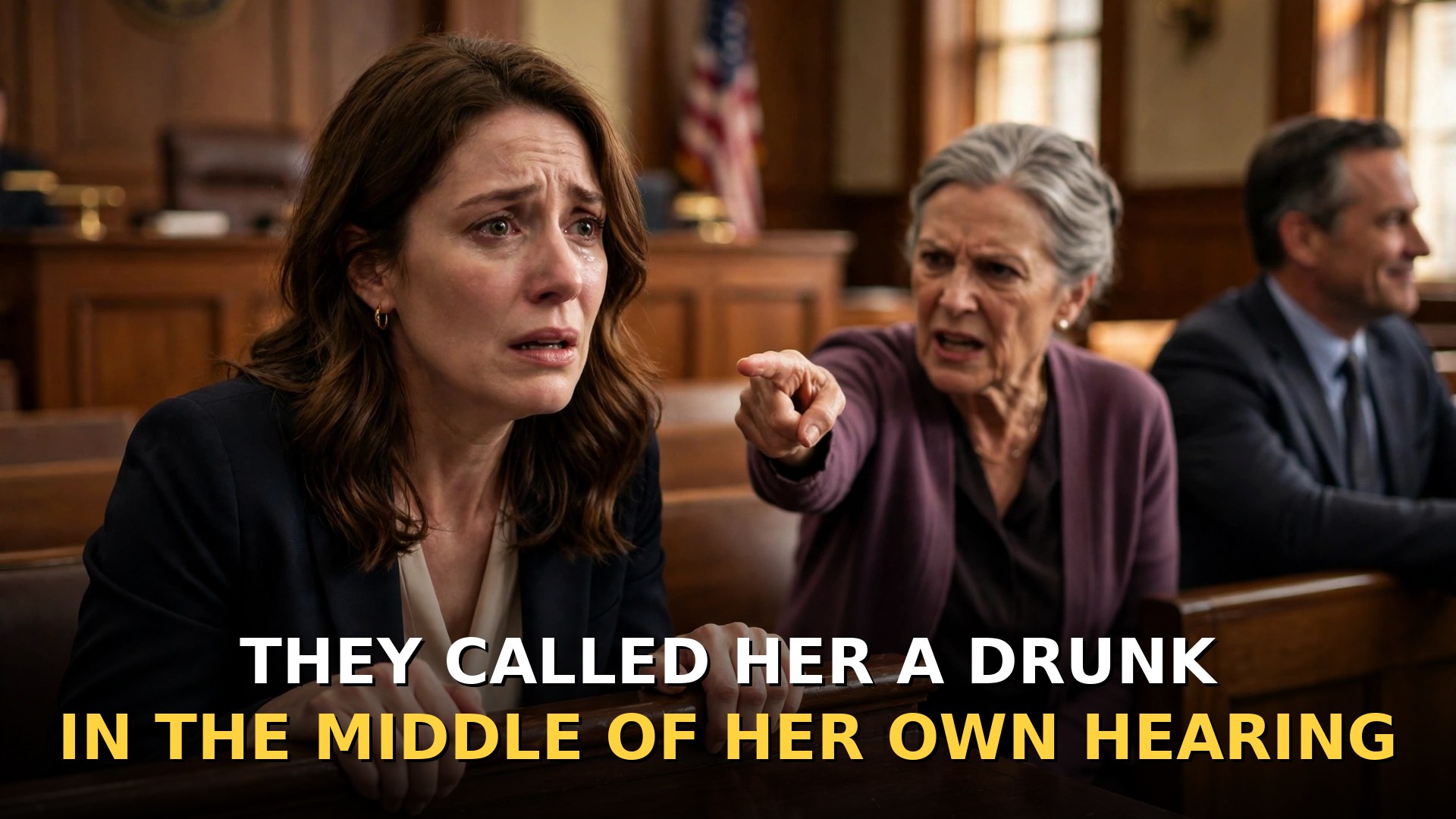
It worked for the woman they called a drunk in open court.
It can work for you.
— THE END —
Thank you for reading "She Wasn’t Drunk." More true-to-the-heart stories every week at dailyhubs.vip.
