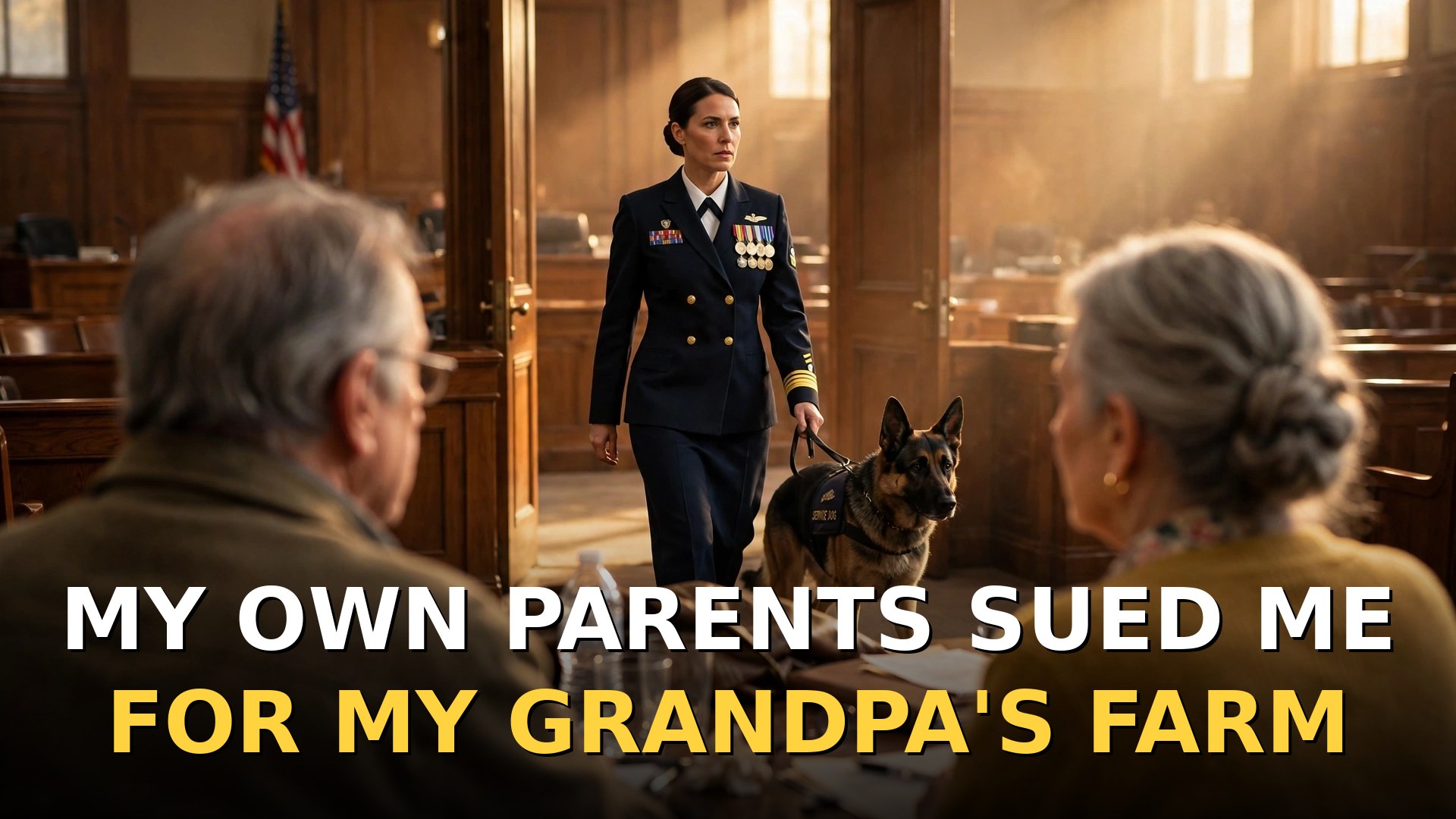
The Commander They Disowned
Part 1 — The Uniform They Laughed At
I walked into that courtroom wearing the uniform I had not put on in nine years, and my father laughed.
Not loud. My father never does anything loud. It was the small sound he makes through his nose, the one from every report card, every recital, every airport goodbye of my childhood — the sound that means: look what she’s done now.
My mother looked at the rows of ribbons on my chest the way you look at a stain on a tablecloth. "Claire," she murmured, as I passed their table. Just my name, like a diagnosis.
Then the judge looked up from the case file — and his hand started to shake.
I saw it before anyone else did. Judges’ hands do not shake. Judge Alan Pierce had been on that bench twenty-two years, and the bailiff told me later he had never seen the man rattled by anything, not even a defendant lunging at a witness in 2016. But his right hand trembled against the folder, and he said, very quietly, "My God. Is that really you?"
Every head in Suffolk Circuit Court turned toward me.
Two days earlier, I had been on my knees in the azalea bed at the farmhouse when the mail truck slowed at the gate. Ranger heard it first — Ranger hears everything first, it is the whole reason he sleeps across my bedroom doorway — and by the time I stood up, brushing dirt off my jeans, the carrier was holding out a thick cream envelope that needed a signature.
Return address: Suffolk Circuit Court, Virginia.
It was not an invitation. It was a summons.
Case 1187-C. Donovan versus Donovan. Petition for partition of real property. Plaintiffs: Frank and June Donovan. Defendant: Claire Donovan.
My own mother and father were suing me for my grandfather’s farm.
I read it twice at the kitchen table with Ranger’s chin heavy on my boot, and then I laughed — one short, ugly laugh — because there was nothing else in me that fit. "Well," I said to the dog. "Eleven years of silence, and this is how they call."
Eleven years since I had stood in their driveway in my dress blues, fresh out of training, with my seabag over my shoulder. My father did not come out of the house. My mother texted me that night, one sentence, and I have carried it in every pocket of every uniform since: "We raised a daughter, not a soldier."
So I went and was a soldier. I stopped writing home by the second deployment. Not out of cruelty — out of arithmetic. There is only so much of yourself you can spend on a door that never opens when other people’s sons are bleeding under your hands.
The patrol outside Gardez is the reason I limp. The vehicle behind mine took the blast, and Chief Eli Harper — thirty-three years old, two kids, the funniest man I ever served with — did not come home from it. I came home with a knee built out of other people’s hardware and a pension I never mention at dinner parties, because there are no dinner parties.
The farm is the one thing that was ever simply mine. My grandfather, Silas Donovan, left it to me outright — ninety acres, a white farmhouse with a porch that lists two degrees to the south, and the pecan grove he planted the year I was born. I have paid the property taxes on it every single year since 2012. Every year. From a ship. From a hospital bed. From a tent with a satellite uplink and a finance clerk who thought Virginia was a person. The county has my receipts.
My parents’ petition said the farm had been abandoned. Said they had maintained it and paid every expense themselves for a decade.
That is not a misunderstanding. That is a lie with a case number.
The night the summons came, I opened the cedar chest at the foot of my bed. Salt, oil, old canvas. My dress blues, folded like they’d been waiting. Harper’s flag in its triangle case, which his widow asked me to keep because her youngest was afraid of it in the hallway, and I have never once considered giving it back unasked.
Ranger sat in the doorway and watched me take out the jacket.
"They’re going to meet the person I actually became," I told him. "Not the one they invented."
In the morning I pinned every medal back where it belonged. The jacket was snugger than I remembered. My knee announced itself on the courthouse steps. But the weight across my shoulders was the most familiar thing in the world.
Not comfortable. Mine.
In the courtroom, their lawyer — a man named Victor Hale, in a suit that cost more than my truck — laid out the abandonment story like a man setting a table. Then Judge Pierce asked my father directly whether he was truly claiming his daughter had deserted the property.
"Yes, Your Honor," my father said. "The place sat empty. June and I paid for everything."
The judge turned to me. "Commander Donovan, would you like to respond?"
My father’s little laugh died in his throat. My mother’s fingers closed around her purse strap.
And before I could answer, Judge Pierce picked up the cream-colored folder, looked at my parents over his glasses, and said the one sentence that changed the temperature of the whole room—
