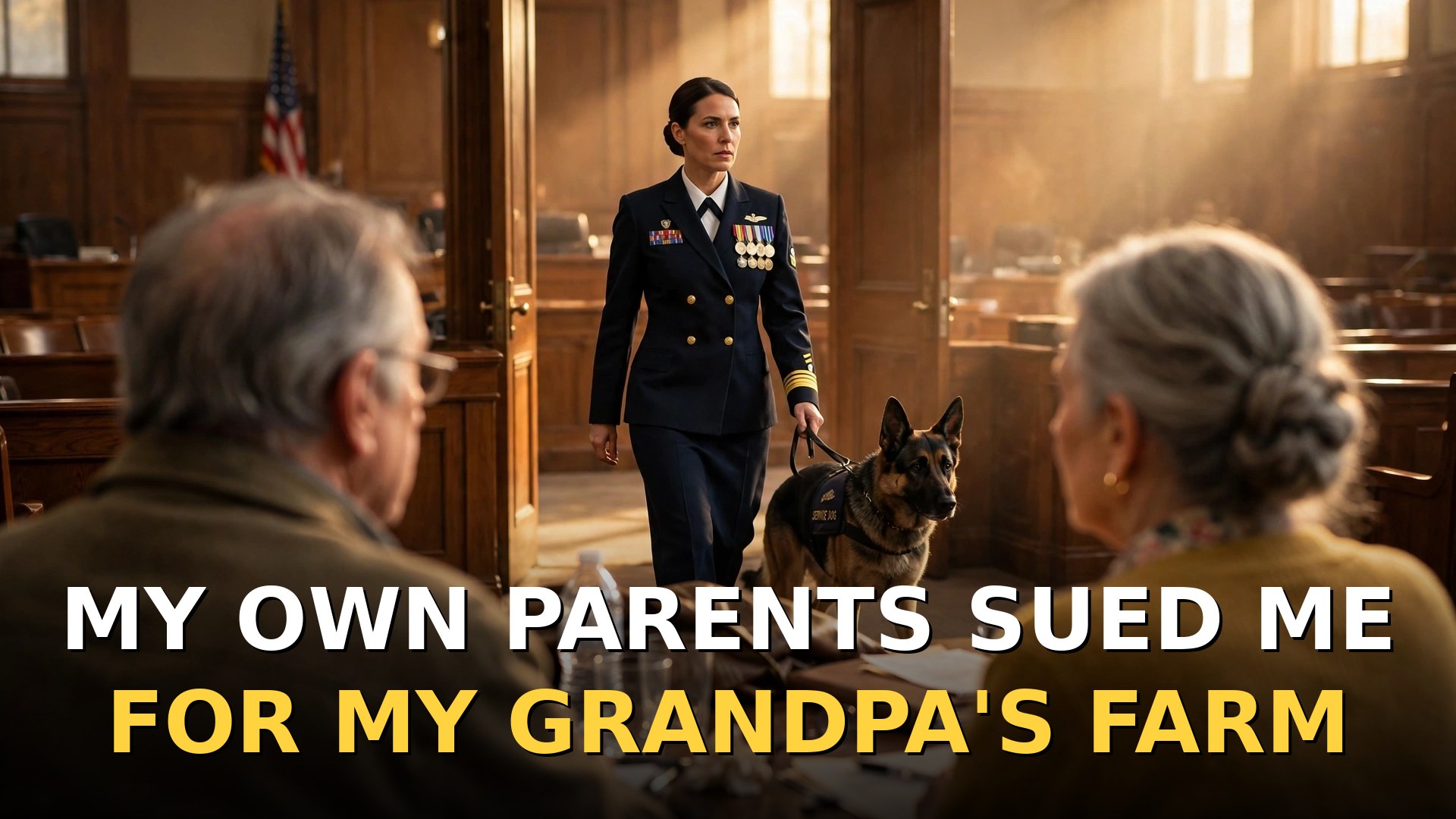
Part 2 — "My Son Lives in That House"
"—this farm has not been sitting empty, Mr. Donovan. My son has been living in it for the past eighteen months."
The courtroom went so quiet I could hear the clock over the seal of Virginia.
My father’s mouth opened. Nothing came out. In thirty-eight years I had never seen Frank Donovan without a sentence ready, and I stood there in my dress blues and watched him reach for one and find the shelf bare.
Hale recovered first — men who bill by the minute always do. "Your Honor, if the court has some personal connection to this property—"
"I know exactly what it means, counselor." The judge set his glasses down with enormous care, like a man defusing something. "Which is why it goes on the record now, before anything else is said in this room."
Then he told it.
Three years ago, outside Gardez, a convoy hit an ambush and a buried charge, and the second vehicle went up in fire. His son — Lieutenant Josh Pierce, twenty-six — was trapped in it with a crushed leg. The officer who went in after him, who dragged him clear on a knee held together by plates and screws and what the surgeons later called optimism, did not give her name. She stayed until the medevac lifted, and then she was gone.
"I met her once," Judge Pierce said. "Ninety seconds, in a corridor at Bethesda. She was in uniform. She told me my son would keep the leg’s worth of life, if not the leg, and that he talked about my pecan pie the whole flight in. Then she limped away before I could ask her name. I have looked for that face in every crowd for three years."
He looked at me. "She didn’t want thanks. She wanted to go back to work."
There is a thing a courtroom is not built for, and it is a judge with tears in his eyes recusing himself from your case. But that is what he did — on the record, with the reason stated plainly, the case reassigned to Judge Rosa Delgado, a new date to be set. He thanked me. He thanked me, in front of my parents, in the voice of a father and not a judge, and he adjourned.
In the hallway, my mother found her voice first. "Strangers," she said. "You have strangers living in your grandfather’s house."
"They’re veterans, Mom. Josh has a prosthetic and nightmares you can hear through a wall. Marcus has two. They live there because they can’t sleep in their own beds yet, and the farm is quiet, and nobody there asks them to be fine."
"You let our family’s land become a—" my father started.
"A home, Dad. It’s a home. That’s what it was when Grandpa had it, too." And then, quieter, because I saw Hale watching us like a man memorizing a menu: "You said in there the house sat empty. You knew it didn’t. What is the land worth to you, exactly? You never wanted it when it was just a farm."
"You have no idea what that parcel is worth," he said, and walked away down the marble hall with his shoes ticking like a metronome.
That was when Nadia Brooks found me — Hampton Roads Veterans Legal Clinic, sent by Josh, because Josh knows I would rather face a Taliban ridge line than hire a lawyer. She took one look at my face, handed me coffee she had somehow already bought, and said, "Commander. Breathe. Then tell me everything."
I had just started when Hale reappeared with a process server and the particular smile of a man producing a rabbit.
"An amended petition," he said, "and the true will of Silas Donovan, dated October 2007, leaving the farm to his son Frank — as Mr. Donovan always maintained." The server put the papers in my hand. The signature at the bottom was my grandfather’s. I would have known that fountain-pen W anywhere on earth.
Nadia read my face. "Claire?"
"That’s his signature," I said. "That’s really his signature."
And standing in that courthouse hallway, for the first time since the summons came, I was genuinely afraid.
