Part 2 — The Envelope
George opened it with my permission, with witnesses, the way my father would have insisted: everything above board, everything on paper.
Inside: a three-page letter in my father’s handwriting. A silver flash drive. A notarized document. And a blue folder with a label in block capitals: THE BRENNAN FAMILY TRUST.
"There is no probate delay for anyone to hide behind," George said. "Your father’s entire estate passed into this trust, and it passes to you alone, Beth — as your separate property. Not marital property. Not pledgeable by a spouse, a relative, or a business. No one in this room can touch it, lend against it, or promise it to a creditor. Your father signed it two years ago. He reaffirmed it two weeks before his death — the same day he sat for a full cognitive evaluation, with two attorneys and two witnesses, because he wanted no one —" he looked at Ryan over his glasses "— to ever argue he didn’t know exactly what he was doing. He’s the soundest man I ever represented. It’s not close."
The thirty-five-thousand-dollar deposit on the Wexford house had already been wired — out of Ryan’s firm account. An account, Priya said, funded by the credit line with my name forged on it.
Then George let me read the letter aloud, because my father wrote it to be read aloud, in that room, and my voice only broke once.
"A leak doesn’t announce itself," my father wrote. "It takes the house a teaspoon at a time, and by the time the ceiling caves, the water’s been in the walls for years. Beth, I saw the leak in your marriage a long time before you did. I am sorry I was quiet. A father doesn’t always know the difference between respecting his daughter’s choices and abandoning her to them. I have stopped being quiet now."
He wrote that being deceived says everything about the deceiver and nothing — nothing — about me. He wrote that in March, when I thought I was just having a checkup, Dr. Okafor had examined me at his request and her sworn letter sat in that folder: healthy, capable, sharp as a tack. He wrote that Lorraine was frightened, not wicked, and that if she did the right thing at the end, I should let her. And he wrote that the money was the least important thing in the trust — "Use it to feel free, Beth. Not safe. Safe is a locked room. Free is a door you hold the key to."
Ryan said my father was paranoid. He said it to the detective. Then Priya opened her laptop, and paranoia left the room.
The home-equity application had been submitted from an IP address registered to Ryan’s office. The signature on it was traced — my name, copied from my passport application, down to a tremor in the capital B that appears in my real signature exactly never the same way twice, because real hands do not sign identically. Traced signatures do. The Wexford contract had been notarized by a mobile notary named Carl Dutton, who had logged an ID number that was not mine, and who remembered everything: a nervous man in a gray suit, pre-signed papers, a wife "too grief-stricken to attend," and a twenty-dollar tip to hurry.
And in a backup of Ryan’s business email sat a document with a date three weeks in the future: a Petition for Temporary Conservatorship. Petitioner: Ryan Callahan. Subject: me — described as increasingly forgetful, unable to manage finances, a danger to the estate.
"A contingency," Ryan said. "A draft. Lawyers draft things."
"You photographed me crying," I said. It came out very calm. "You asked me every night if I’d taken the sleeping pills you kept in your nightstand. Pills your doctor friend mentioned. You asked Dr. Cho twice — twice — to write down that I was forgetful. That isn’t a contingency, Ryan. That’s a construction project."
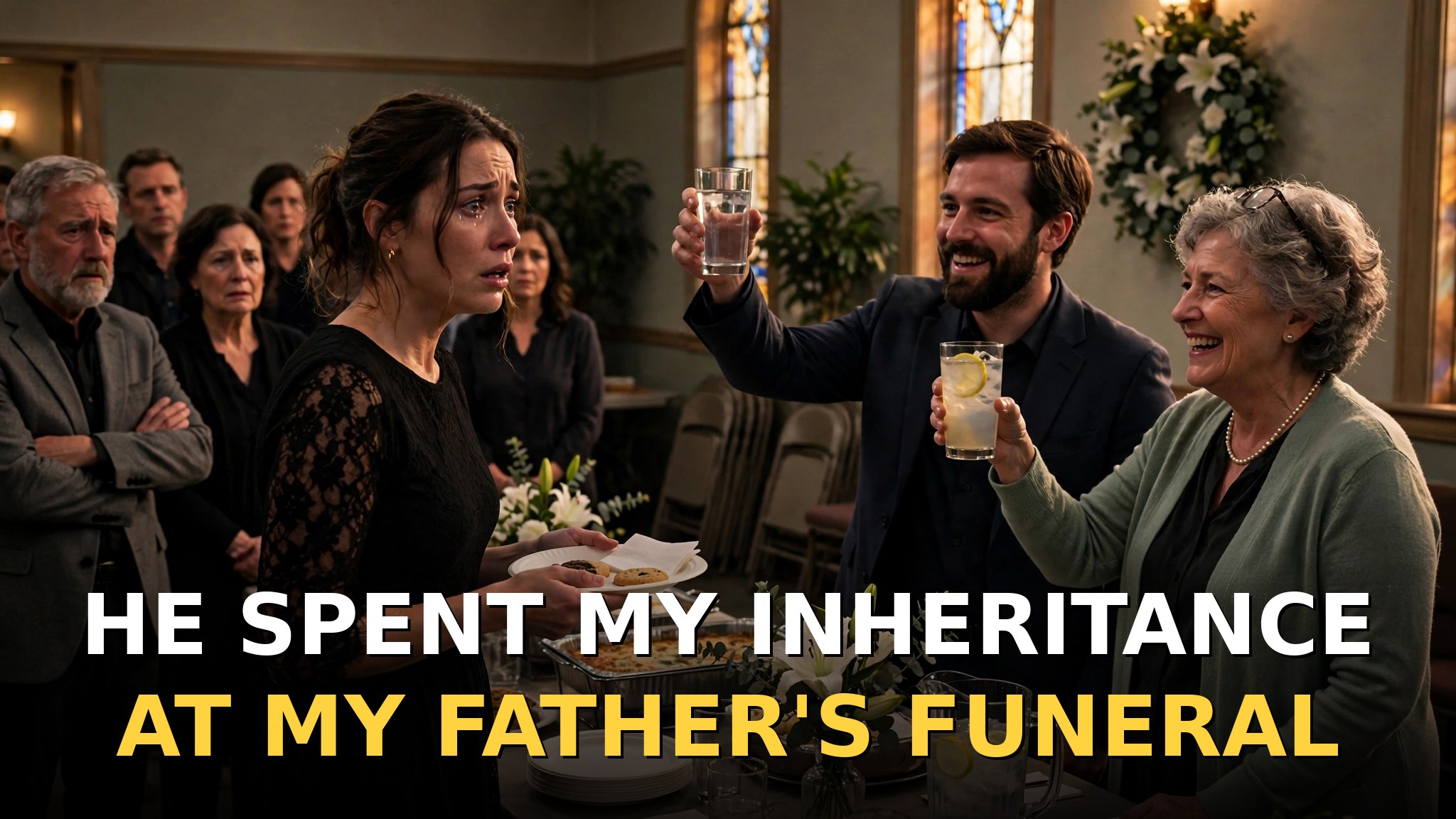
Lorraine was crying openly by then, mascara in runnels. "He told me it would only be temporary," she said to the room, to God, to anyone. "That Beth would rest. That she’d be looked after. I just — my condo — I was going to lose my condo—"
"Mrs. Callahan," Detective Jensen said, not unkindly, "I need to advise you that you don’t have to keep talking."
Priya totaled it the way you’d total a wreck. Lorraine owed a hundred and eighteen thousand dollars — a refinance, a failed condo investment, a private lender with a friendly voice. Ryan had opened three credit cards and a personal loan in my name. And over eleven months, he had siphoned sixty-three thousand dollars out of our joint savings to plug the holes in Crestline Advisory.
The balance he left in our savings account was nine dollars.
Detective Jensen produced the warrant — signed that morning at nine o’clock. Forgery. Identity theft. Financial fraud. Ryan turned to me with a face I had loved for eleven years, and he begged. Not apologized. Begged. "Beth. Tell them you signed. Tell them you forgot. People forget things. One sentence and this all—"
"No," I said.
They handcuffed my husband in the conference room where we’d read my father’s will, and he said, "Eleven years, Beth," and I heard my father’s voice from the phone, level as a meter: the money is the least important thing.
"Remembering you isn’t the same as staying," I said. "Goodbye, Ryan."
