Part 5 — I Did It
Sentencing day was the color of dishwater, and I wore the black dress. Not the funeral one — a different one. I’d thought about that more than I’d admit to anyone but Katie.
I had written out my victim statement, four pages, careful as a lesson plan, because I am a teacher and that is how I survive things. And then I stood up in that courtroom, looked at the judge, looked at Ryan in his too-big suit with his hair cut by the state, and I set the pages face-down on the rail and I spoke from memory.
I said the money was the smaller part, and I watched a juror’s pen stop moving when I said it. I said what can’t be restituted is the time — the eleven months of teaspoons, the years I spent believing I was forgetful, dramatic, too much, not enough — standing in my own kitchen at midnight wondering if I was losing my mind. "Nothing was wrong with me," I said. "I was grieving. There’s a difference, and my husband built a business model on the difference."
I asked the judge for a sentence that would protect the next person — because there is always a next person standing where I stood, and she does not have my father. And I said to Ryan, because he was there and it was my one chance to say it in a room where it becomes record: "My silence was never weakness. It was a woman learning exactly what she was standing next to. I’ve learned. That’s your whole sentence, as far as I’m concerned. The rest is just time."
Six years in state custody. Five years of supervised release after. Full restitution, out of everything Crestline had left and everything he’d ever earn legitimately again. No contact, ever, and counseling and financial-ethics courses the court would choose, not him. At the door, being led out, he stopped and mouthed it at me: I’m sorry. I let him see that I heard it. Then I let him go — the way my father taught me everything important, years before I knew I was learning it.
I walked out of that courtroom feeling like a heavy coat had slipped off my shoulders in a doorway.
Lorraine’s case resolved a few weeks later. For the shoebox, for her testimony, for agreeing to repay what she could — probation, one hundred and eighty hours of community service, a repayment order. She sold the condo and moved into her sister’s spare room two states away. Her two-page handwritten apology lives in my father’s desk drawer, unanswered. I don’t say that with cruelty. Some letters are for the person who wrote them. George says she’s current on her payments. My father said frightened, not wicked. I’m working on it. It’s work.
The divorce was final in March. I signed the papers with my maiden name — Brennan — and I noticed, signing, that my hand was steady, and my letters were bigger than they’d been in years.
In April, Detective Jensen released my father’s phone from evidence, and George brought it to me in his office, and there it was: one unplayed file. And on the case, in my father’s handwriting, on a piece of masking tape:
FOR BETH. AFTER.
He’d recorded it from his hospital bed, propped up against pillows, thinner than I let myself remember, in the cardigan with the leather buttons. He told me about the summer I was six, learning to ride my bike on Maple Street. How he’d run behind me holding the seat, and how, somewhere past the Ruizes’ house, he’d let go — and hadn’t told me. And I’d ridden the whole block, wobbling like a drunk sailor, shouting I DID IT, I DID IT, like I’d invented the bicycle.
"That’s the whole job, kiddo," said my father, from his hospital bed, from the far side of everything. "You hold on as long as they need. Then you let go, and you don’t tell them, because the knowing is the prize. Loving you was never a mistake. Don’t you dare file it as one. And that money — don’t use it to feel safe, Beth. Safe is a locked room. Use it to feel free. And when you’re standing steady — build a door for somebody who’s standing where you were. Nobody needs four bedrooms. Buy a porch swing instead."
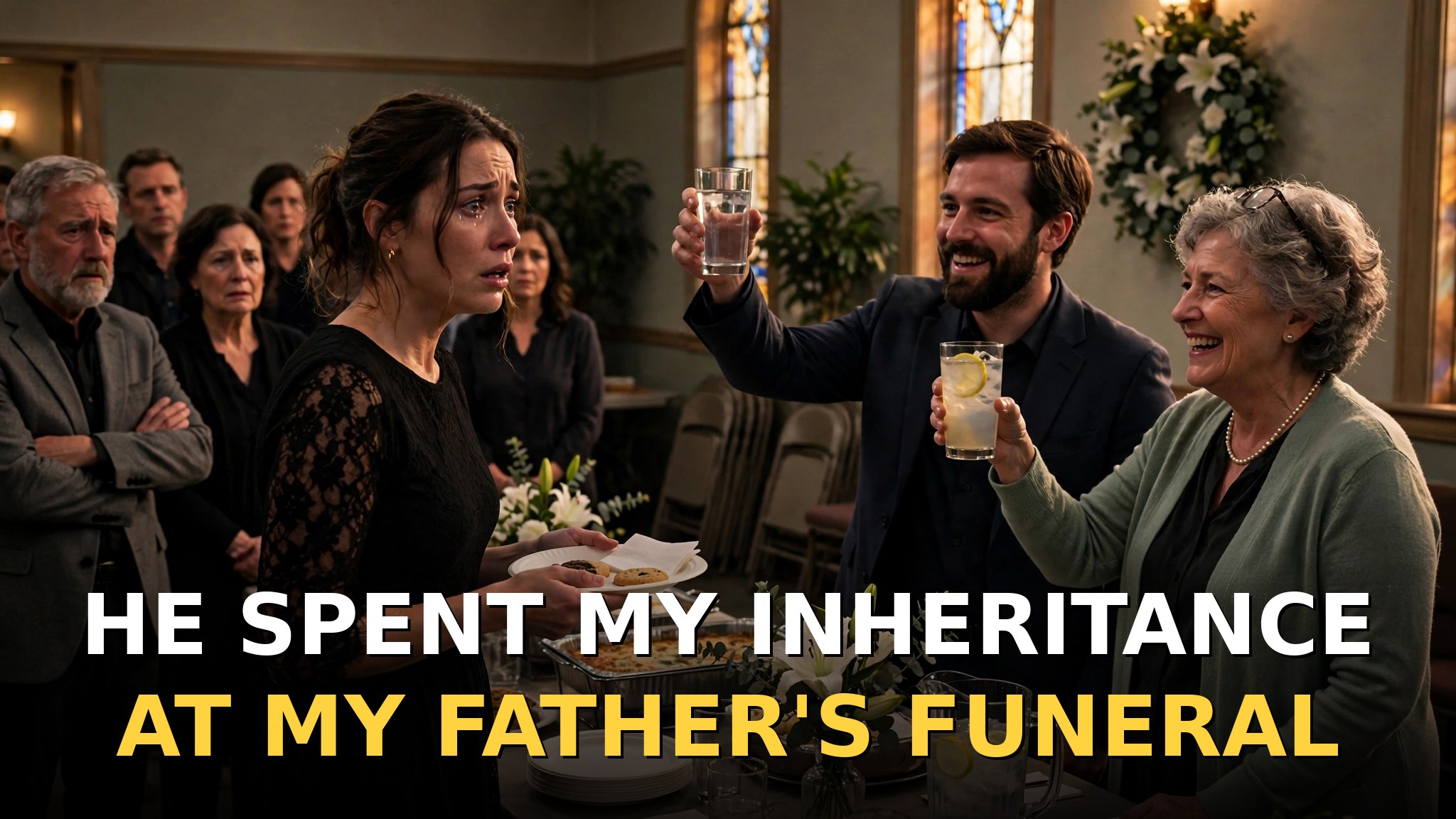
The following spring — eleven months after I stood in a church hall holding a paper plate and saying nothing — we launched the Thomas Brennan Open Door Fund in that same hall, with the same folding tables, and nearly two hundred people came.
The fund does what my father did with a phone and a Tuesday phone call: it finds the leak early. Free legal help for people whose own families have used their trust against them. Accountants who care. A counselor-led group on Thursday nights in a lit church basement, for the person sitting in a kitchen at midnight thinking they’re losing their mind. Priya runs the numbers side. George volunteers two days a week. Dr. Cho leads the Thursday group. Katie does outreach, and Detective Jensen came to the launch in a plain blue dress, off duty, and stood in the back like a neighbor, which by then she nearly was.
I stood at that podium in the room where my husband had spent my inheritance out loud, and I said:
"A year ago I stood in this room and said nothing, and it was the loudest silence of my life. Today this fund buys lawyers who don’t charge and accountants who answer and a warm room on Thursday nights. If you are standing where I stood — you are not foolish. You were generous with someone who was not. Those are different things. My father knew the difference. Now there’s a door with his name on it, for you."
I found his photograph afterward on the memorial table — the old ball cap, the crooked grin, a man who held the seat and let go at exactly the right moment. "I did it, Dad," I told him.
I never bought the Wexford house. It went to another family, with kids, and a dog I’ve since met, and I wish them every happiness in it. I kept my father’s little two-bedroom on Maple Street — the crooked mailbox, the screen door that squeaks in B-flat, the irises that came back that spring like they’d never heard a word of any of it. I painted the kitchen a soft yellow. I planted white lilies under the front windows. And I hung a porch swing, because a dying man is rarely wrong about furniture.
Last week, at golden hour, I sat on that swing with my father’s black phone resting on the arm, and watched a father jog down Maple Street behind a little girl on a bicycle — holding the seat, puffing, grinning. And at the corner, right by the Ruizes’, the girl turned her head. Realized the hands weren’t there. Realized she had been riding alone, perfectly, for half a block.
"I DID IT!" she shouted, at the whole street, at the sky, at nobody and everybody.
"I know you did, sweetheart," I said, from my father’s porch, in the golden light, with the neighbors’ lights coming on one by one down Maple Street.
I was exactly the woman my father raised. THE END
