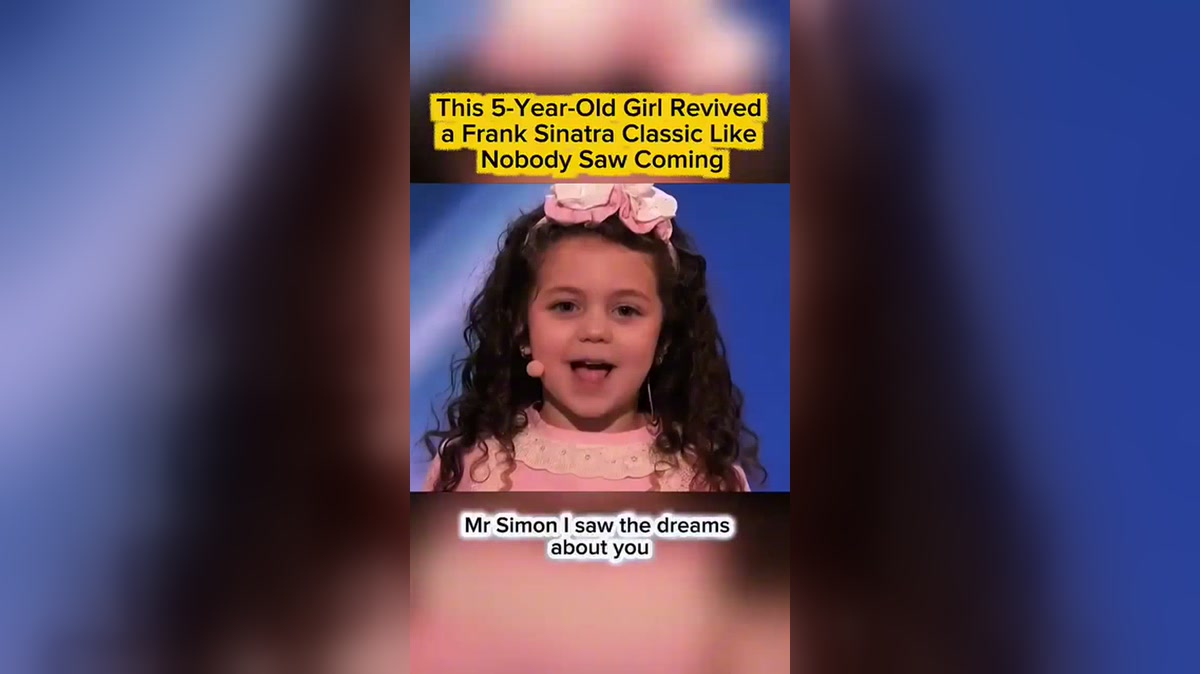
Five-year-old Sophie Fatu arrived at the America’s Got Talent 2018 auditions dressed in pink and carrying herself with the cheerful confidence of someone who had not yet learned that Frank Sinatra songs are supposed to be intimidating. Then she sang “My Way,” shaping the famous standard with tiny gestures, a steady sense of time, and a personality much larger than her physical presence onstage.
The performance became a viral favorite because it contains an irresistible contrast. Sophie looked like she might be heading to a school recital, yet her phrasing belonged to the world of lounge singers, big bands, and old standards. The judges’ smiles were immediate, but the audition was more than a cute imitation.
She understood the character of the song
“My Way” is written as a reflection on a lifetime of choices. A five-year-old obviously cannot bring decades of experience to that lyric, so Sophie solved the problem through character. She leaned into the song’s formality, pronounced the ends of phrases clearly, and used direct eye contact as if she were telling the room a very serious story.
That approach kept the performance from becoming a simple novelty. She was not trying to sound like an adult in every technical sense. Instead, she understood the style: hold the tempo, let important words land, and present the melody with confidence. The mismatch between lyric and age became playful without turning the song into a joke.
Timing was her strongest musical tool
Young singers often rush when they are excited. Sophie did the opposite. She waited through the instrumental spaces and entered phrases with surprising patience. Her pitch wandered in places, as one would expect from a singer that young, but her rhythmic memory remained reliable. She knew where the line was going and how long to leave the audience waiting.
That timing also supported her stage presence. Small hand movements and facial expressions arrived on musical beats rather than appearing randomly. The result felt rehearsed but not mechanical. She seemed to be playing a role she genuinely enjoyed.
The judges responded to confidence and charm
Simon Cowell, Heidi Klum, Mel B, and Howie Mandel all advanced Sophie. Much of their response focused on her personality, and that was appropriate: the audition worked because the voice, the song choice, and the presentation formed one coherent character. A technically stronger singer without that connection to the material might have been less memorable.
Sophie returned for the Judge Cuts round with another Sinatra standard, “New York, New York.” Before singing, she told the judges that making people happy mattered more to her than the prize money. She did not advance to the live quarterfinals, but the second performance showed that the audition was not a one-song accident. She had developed a recognizable style around classic material.
Why viewers remember the audition
Talent-show clips often depend on a sudden high note or a dramatic backstory. Sophie’s appeal was simpler. The audience could see a child enjoying the act of performing. She did not appear frightened by the panel, and she did not need the song to be rearranged into a modern pop showcase. She trusted the melody and the character.
The audition also demonstrates why “age-defying” should not mean pretending age is irrelevant. Sophie’s youth is central to the pleasure of the clip, but the performance succeeds because she contributes musical choices of her own: measured entrances, clear diction, and playful seriousness. Those choices make the moment worth revisiting long after the initial surprise wears off.
Watch Sophie’s full audition
Sources
- TV Guide: Sophie Fatu returns for Judge Cuts
- Just Jared Jr.: Sophie’s “My Way” audition
- Full audition video
Analysis based on the supplied video excerpt and the full performance and reporting linked above.
