Part 5 — Never Too Late Until It Is
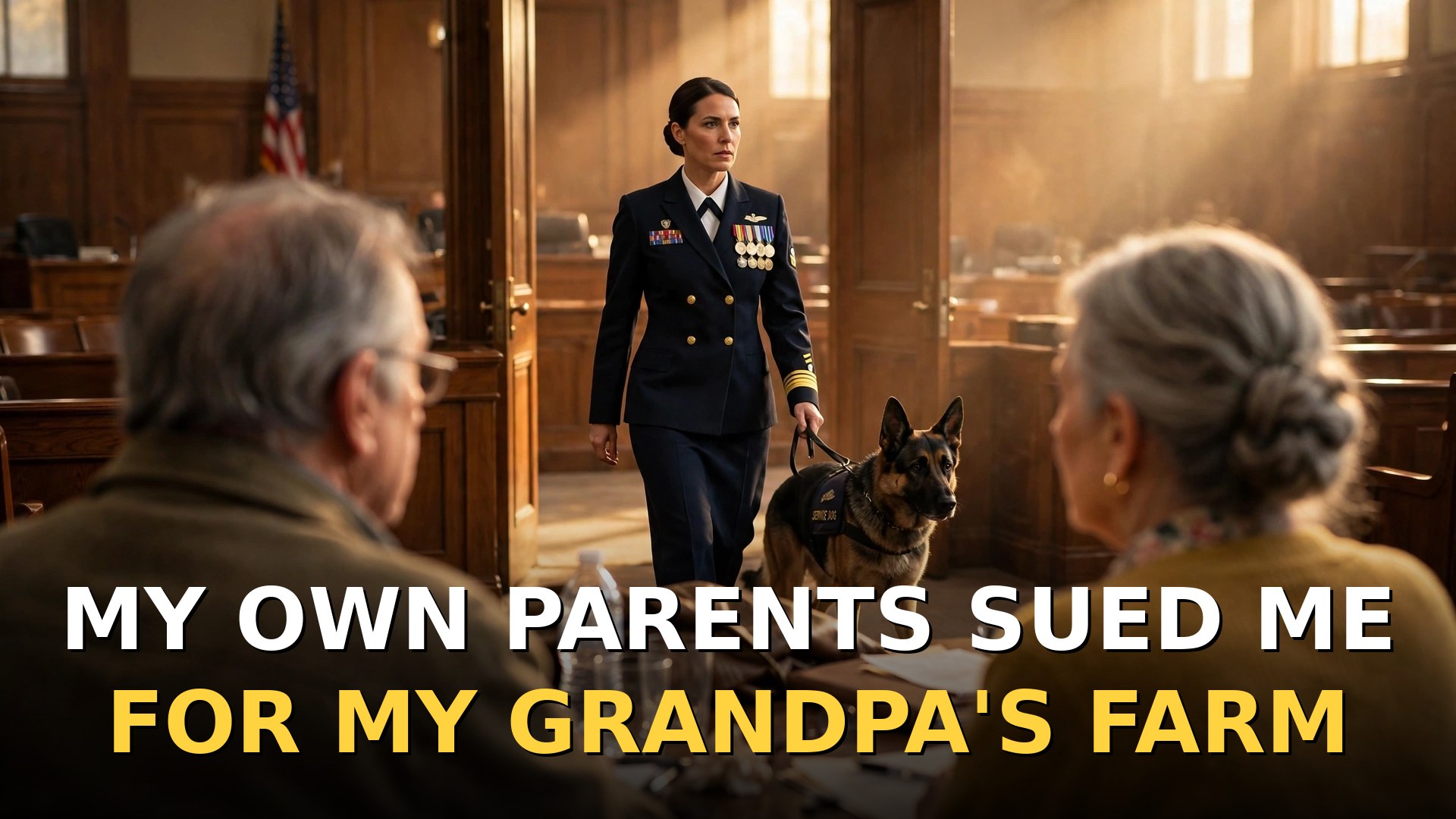
The final hearing was set for the first Monday in December, and my father arrived looking like a man who had aged ten years in a month, and my mother arrived separately, in a blue dress I had never seen, and sat — with eleven years of unopened letters read and re-read behind her eyes — on my side of the aisle.
Nadia played the recording first.
There he was. Silas Donovan, eighty-one years old, in his brown cardigan, in Howard Bell’s office with the afternoon coming through the blinds. "My name is Silas Reed Donovan," he said. "I am of sound mind. I know exactly what I’m doing, and anyone who says otherwise can take it up with me in the next world, because I’ve made my peace in this one."
Eleven minutes. He spoke about the loan with a sorrow so plain it hushed the room — not anger, never anger at Frank; at what Frank was doing to himself. He spoke about a little boy who’d wanted to be a sailor. He spoke about June, and asked her forgiveness for a secret kept out of love. And then he looked into the camera like a man aiming, and he said:
"Claire. If you’re seeing this, your father has done the thing I feared. I’m sorry, sweetheart. The farm is yours because you’re the one who’ll take care of it. Not keep it. Take care of it. There’s a difference, and you always knew it." His voice thinned. "And Frank — son — if you’re watching too: it is not too late to be the man I buried a flag for hoping you’d become. It’s never too late. Until it is."
The forensic examiner from Richmond was almost gentle about it after that. The signature on the 2007 will and the signature on the 2008 loan application were identical — the same pen pressure, the same hesitation at the top of the W, the same tremor. "Genuine signatures are never identical," she said. "No hand signs twice the same. These were both traced from one source." June testified about the duplicate tax payments, and produced the Harborline purchase agreement she had taken from Frank’s study, signed by Frank Donovan as "owner," with Hale’s own firm listed as escrow agent, and when Hale rose to object, Judge Delgado looked at him the way weather looks at a fence.
"Sit down, Mr. Hale, before you say something I have to report."
And then Caleb stood up in the gallery — unprompted, unsworn, shaking like a leaf in a door — and took it all back. Grandpa never said those things. He had lied about me, lied about the stand, and the night at the farm: Hale’s investigator had told him what to photograph and where the safe was, and the stolen papers were in his truck, and had been, because some part of him had never been able to give them away.
In the conference room afterward, my father asked to speak to me alone, and told me the thing underneath all the things. He had washed out of officer training in the seventh week. Not an injury — the family story, the bad back, was a lie he’d told at twenty-two and maintained for forty years. He had frozen in the deep end of the pool with the weights on, and panicked, and been pulled out while other men’s sons swam on. He watched his daughter walk into every room he had failed out of, wearing the uniform he couldn’t earn, and every success of mine read to him like an indictment. At two in the morning, the night I finished training, he took his wife’s phone and typed the sentence he’d spend eleven years hiding behind.
"I’m not asking you to forgive me," he said. "I don’t get to ask that."
"No," I said. "You don’t. But Grandpa said it’s never too late until it is, Dad. And it isn’t yet. That’s all I can give you, and it’s more than you gave me, and it’s real."
Judge Delgado ruled that afternoon. The 2007 will: a forgery, void in its entirety. The 2011 will: affirmed in full. The petition: dismissed with prejudice. Claire Donovan: sole lawful owner of the Silas Donovan farm, confirmed — and attorney’s fees against the plaintiffs. The forged will, the loan application, and the break-in went to the Commonwealth’s Attorney. Victor Hale went to the State Bar, which suspended his license that spring. Harborline voided its purchase agreement within the week and drew its access road through somebody else’s field.
Frank pleaded guilty to forgery and obtaining money by false pretenses: a suspended sentence, two years’ probation, and a restitution order to Harborline he will be paying, in monthly installments, for most of what remains of his life. Caleb pleaded to misdemeanor trespass and three hundred hours of community service. He asked the judge if he could serve them at the farm.
Six months later, on a Saturday in June so warm the pecan grove smelled like sugar, about sixty people stood in my yard for the dedication. Josh and Caleb had spent a month on the sign — white oak, hand-routed, set in stone at the gate: HARPER HOUSE — FOR THOSE WHO CAME HOME.
Howard Bell came in a wheelchair and a new red bow tie. Judge Pierce came, and did not make a speech, but I later learned where the money for the new well pump came from. Josh’s people. Marcus’s wife and kids. And my mother — June Donovan, living now in a small apartment twenty minutes away, who had read every letter I ever wrote her in one long weekend and brought me hers, tied with blue ribbon, to keep in the cedar chest next to Harper’s flag. Which is where the flag hangs now, in its shadow box by the front door, where sixty people filed past it that day and every one of them touched the glass.
Josh asked me, in the spring. There was no speech. There was a porch, and a ring that had been his grandmother’s, and a man who calls me Ev when nobody military is listening — don’t ask me why, nicknames outlive their reasons — saying, "I keep coming back to this family, Commander." His father’s Christmas toast is famous in two counties now: "To the Commander, who keeps coming back for my family."
That evening, after the last truck left, an old sedan idled at my gate for a long time. Frank didn’t get out. He sat with his hands on the wheel and looked at the sign, and the porch light, and the flag in the lit window, and then — slowly, like a man saluting something he has finally learned to recognize — he raised one hand off the wheel.
I raised mine back.
It was not forgiveness. Not yet. But it was not the end of the story, either — and on the drive home he would pass the pecan grove his father planted the year I was born, still standing, still mine, still feeding people.
The weight I’d carried into that courtroom was never the uniform. It was everyone I have ever carried home, and everyone I couldn’t, and the people who finally learned to carry a little of it with me.
Not comfortable. Mine. THE END
