Part 3 — "I’m Going to Believe the Evidence"
The recording filled my son’s dining room like weather.
Kayla’s voice, laughing: "Once his promotion lands, we move her somewhere smaller. She’ll cry, and then she’ll go. She always goes along in the end."
Ray’s voice: "Let her think we’re helping. She sells that old house, the boy can finally stop worrying about her — and there’s money in that house. Real money."
Darlene’s voice, fond as poison: "She has no idea what that place is worth. Bless her heart."
And Kayla’s laugh again, the one I’ll hear in my sleep some nights: "She trusts David completely. That’s the easy part. Eventually David chooses us. He always does."
The recorder clicked off.
Nobody in that room breathed right for a while. Edith had her hand over her mouth. Ray was looking at the floor like it might open. David — my son, my boy, the pale quiet man at the head of the table — David was looking at his wife of six years like she was a letter he’d been reading upside down.
"Is that why you kept telling me Mom was controlling me?" he said. "Every Sunday. Every phone call. Three years, Kayla. Was the money always the plan?"
"Recordings can be edited," Ray said, quick, from the floor of his dignity. "Anybody can fake—"
I opened the second envelope. Bank statements. Messages. Dates. Receipts. Hank does not deal in impressions; Hank deals in paper. "Then let’s use the unedited kind," I said. "Read, David. Take your time. I waited three years. I can wait an hour."
He read with his hands shaking, page by page, while his wife stood against the wall with her arms wrapped around herself like the room had gone cold. I watched three years come apart on my son’s face — every manufactured conversation, every Sunday he’d been steered out of my kitchen, every time he’d repeated her words to me in her voice and thought they were his.
"Mom—" he said, and broke.
"Don’t apologize yet," I told him, gentle as I could. "Every time I tried to tell you, you heard her. That’s not a sin, David. That’s a marriage. She just spent yours."
Kayla made her last play then. She grabbed his arm — "You’re really going to believe HER over ME? Your own wife?" — and David pulled his arm away like it was his to take back, which it was.
"I’m going to believe the evidence," he said. And then he raised his voice — my son, who has not raised his voice in my hearing since he was fifteen years old and six feet tall in a doorway — "ENOUGH." The glasses trembled on the table. "You didn’t just reach for money that belonged to my mother. You reached for her place in my life. For three years. That’s not a mistake, Kayla. That’s a campaign."
"David, I love—"
"Maybe you did." He was crying now and not hiding it. "But love doesn’t require destroying somebody else. That’s the whole difference. That’s the whole thing."
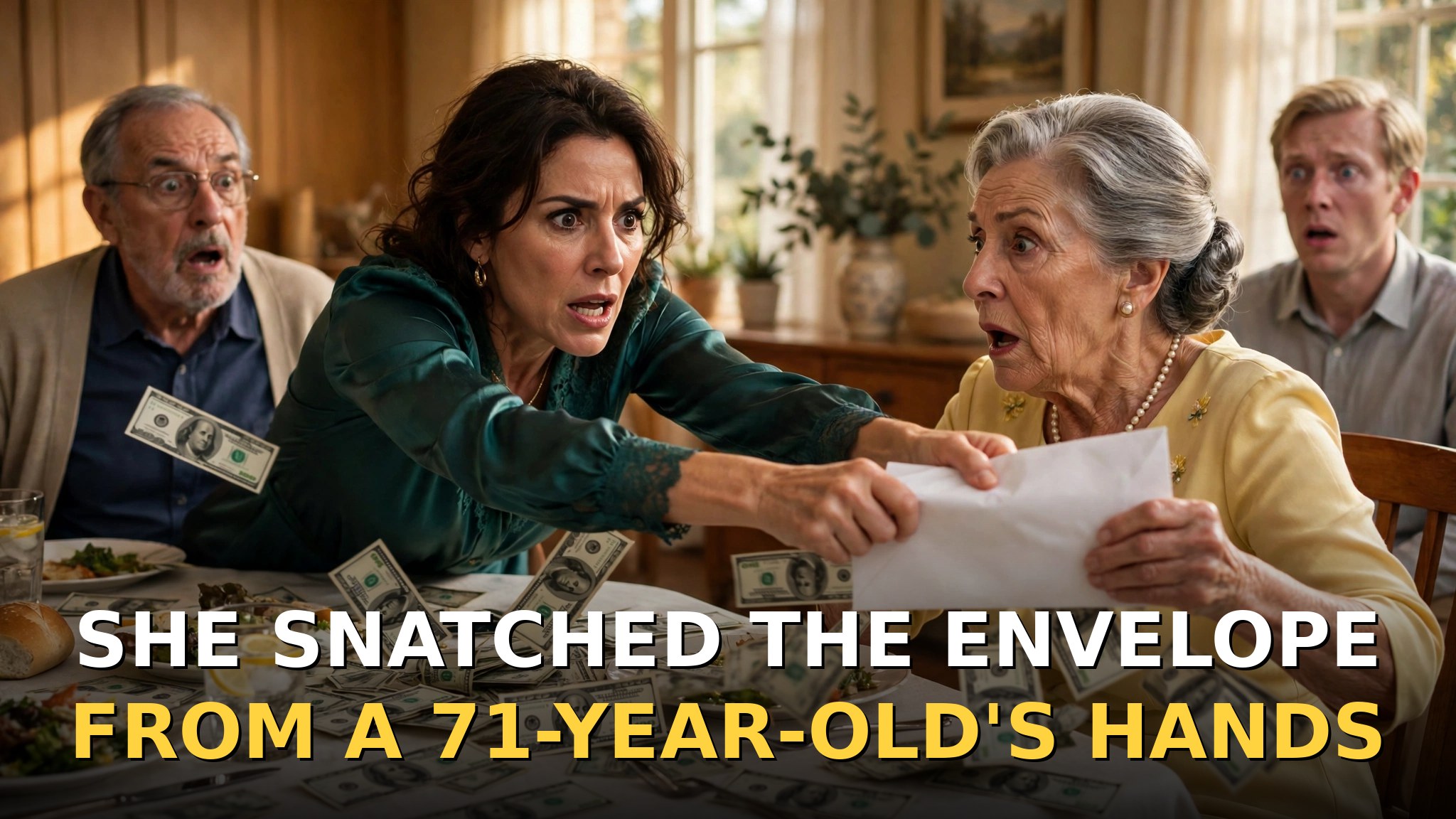
Then my son got down on his knees beside my chair — this tall engineer, this grown man — and gathered up the spilled prop money bill by bill, and squared the stack with his thumbs the way his father taught him to square a deck of cards, and put the envelope back into my hands with both of his.
"It’s yours, Mom. It was always yours."
I closed his fingers back around it. "David Ellison. I do not need your twenty-five thousand dollars, and I never did. You know what you owe me?"
"Name it."
"A phone call. Every Sunday. And lunch once in a while. At my table, in my kitchen, where I can see your whole face."
He hugged me then — the first real hug in three years, the kind with his whole weight in it, like the boy who used to fall asleep against my shoulder in church while I smelled of bleach and did not care who knew it.
