Part 2 — "He Didn’t Start Anything"
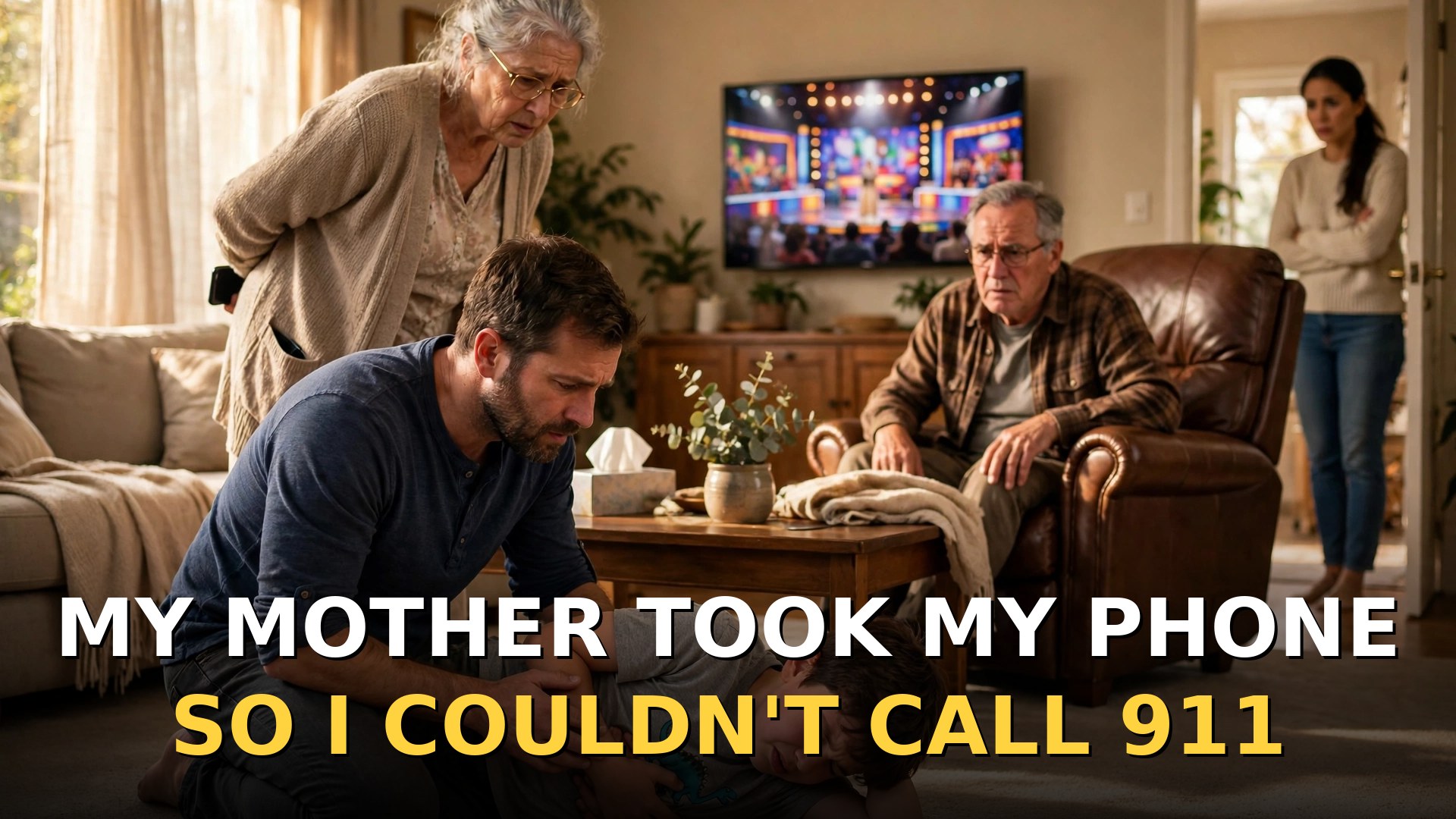
Officer Ruiz knelt down low so the paramedics could work around him, and he asked my mother a direct question in a voice like a man setting down something heavy: "Ma’am. Did you take your son’s phone so he couldn’t call 911?"
She tried "keeping everyone calm." She tried "a family matter." She looked at my father for support and found a man studying his iced tea. She looked at Karen and found a woman studying the wall. And my mother — who has never in her life, in my hearing, used the words I was wrong — said, "Yes. I did."
"Thank you," Ruiz said simply, and let it hang in the air like smoke.
The paramedic, Kate, clipped a monitor onto Eli’s finger and told him he’d done something really, really smart, and asked him to show her where it hurt worst. Low on his left side, just under his arm, where every breath stopped short like it was hitting a wall. "We’re keeping you flat and still, champ. Stretcher’s coming. Dad rides with you."
Karen erupted then — nobody is riding anywhere, you put something like this on paper it follows a child for life, he’s twelve — and Ruiz looked at her with the calm of a man who has had this conversation in a hundred living rooms: "The injured child gets care first, ma’am. Then we establish what happened. You’ll stay where you are."
Officer Chen brought Logan forward. Karen told him he didn’t have to say anything and to come stand by her. Chen said they’d talk with her present — but Logan would answer for himself. Ruiz stepped between my nephew and my mother, in the deliberate way of a man moving a piece on a board, and told Logan to look at him. Not at her. At him. "Start at the beginning, son."
And my mother gave the tiniest shake of her head. I have read that head-shake my entire life. Don’t say. Don’t tell. What happens in this house stays in this house.
Logan broke like a dam.
They’d been playing a game. Eli won. He wasn’t even a jerk about it — he just said good game, the way Eli says everything, like he means it. And Logan got mad. Mad at a game, mad at an eight-year-old, mad at his own life in a way a twelve-year-old doesn’t have words for yet. He pushed Eli off the couch. And on the floor, he kept going. And he heard something — he heard a noise, and Eli made a sound — and he stopped, and he was scared, and he didn’t say anything.
"I didn’t mean it," he sobbed. "I didn’t mean it. And then Grandma—" Karen made a sharp noise and he flinched, but Officer Chen’s hand was steady on the air between them, and Logan finished it, because once truth gets out of a kid it doesn’t stop for anybody. "Grandma said go to the back room and stay there. She said everyone would take care of it. She said if anyone asked, Eli started it. But he didn’t. He didn’t start anything. I did."
As they lifted Eli — so carefully, these strangers, more carefully than anyone in my family had handled him all afternoon — my son turned his head on the stretcher toward his cousin, and he said, wobbling and drugged with pain and entirely himself: "You said sorry. That counts."
Rule of my childhood home, the one written on no wall and enforced at every meal: nobody in this family is ever wrong, and nobody outside this family ever hears about it. One boy broke it by telling the truth. The other one broke it by forgiving him out loud. And every adult in that room looked about two feet tall.
At the door my mother stepped in front of the stretcher — in front of it — and begged me to think about what I was doing to this family. And I felt, God help me, not hatred. Grief. For the woman who packed my lunches. "Mom," I said. "I’m not the one who did this to the family." And I followed my son out into the blue light.
In the ambulance, with Kate at his head and the oxygen on, Eli asked me the question that undid me. "Dad? Are you mad at me? ‘Cause you said only use the button for a REAL emergency. And Grandma and Grandpa got so upset. Did I break everything?"
I told him the truth, with my face right down by his: "You broke nothing. You did exactly what I taught you. If you’re hurt and you can’t get help any other way, you hold that button for three seconds. Even if grown-ups tell you not to. Even then. Especially then. You kept your hand hidden so they wouldn’t stop you, and that is the bravest thing I have ever seen in my life."
He said he wasn’t scared after he pressed it. Because he knew somebody would come. It had never once occurred to my eight-year-old that maybe nobody would — and I sat there in the antiseptic roar of that ambulance wondering how many children learn not to believe that, and how many of the adults who’d taught them "don’t make a scene" had learned it the exact same way. In this family. At that table.
St. Mary’s. Dr. Osei, kind, brisk, a mother herself, with the images up within the hour: one rib fracture, clean, on his left side. His lung is fine. No internal bleeding. Nothing else broken. He’d have a rough couple of weeks — a rib hurts every time you breathe, and you have to keep breathing; that’s the entire curse of it — but children heal like it’s their job.
"You did well, getting help fast," she said. "With these injuries, we always ask how quickly help was called. Minutes matter." I told her it was Eli. All Eli. I couldn’t reach my phone. She smiled the smile of a woman who has also taught a child a small brave thing. "Then it was both of you. You taught him. He remembered."
My wife Sarah arrived twenty minutes later, still in her scrubs, badge on its lanyard, having handed a double shift to a colleague and driven across town at a speed she will deny under oath until retirement. She went straight to Eli and put her forehead against his hair, and this woman — who delivers the worst news a human can get to total strangers three nights a week without her voice shaking — cried over our son until he patted her hand, sleepy, and said, "Hi, Mommy."
