Part 4 — The Letter
Eli came home two days later with pain medicine, a little plastic breathing gadget he had to use ten times an hour to keep his lungs clear, and instructions Sarah taped to our refrigerator with the seriousness of a woman posting scripture. She took a week off. I worked from our kitchen table on Maple Court. Neighbors brought casseroles until our freezer gave up and admitted defeat. Marcus’s mother sent a card signed by the entire third grade. Eli’s teacher reported that his desk held paper flowers and that the class was officially saving his seat.
On Saturday, Karen appeared on our porch.
Old jacket. Lopsided ponytail. No makeup, none of the doorway smile. She asked for five minutes and said upfront she had no right to them — that she wouldn’t yell, and she wasn’t there to ask me to drop anything. Sarah stayed inside with the door closed so Eli wouldn’t hear, and my sister sat on my porch steps and confessed like a woman finally putting down a bag she’d carried so long she’d forgotten it had weight.
She and Logan had barely slept since Sunday. Logan cries at night. He asked her if he’s a bad person, and she hadn’t known what to tell him — because for twelve years, she had told that boy that nothing was ever his fault. Every school, every fight, every teacher’s call: the other kid, the teacher, bad luck. She thought that was what a good mother did. She thought defending him from every consequence was love.
When Ruiz questioned Logan and Logan told the truth, she said, her first feeling was betrayal. At the officer. At me. At my mother. At her own child — for telling the truth. And then she was sick at herself for feeling it.
"That’s the kind of mother I learned to be in that house," I said. It wasn’t comfort. It was a mirror, and she looked into it a long time.
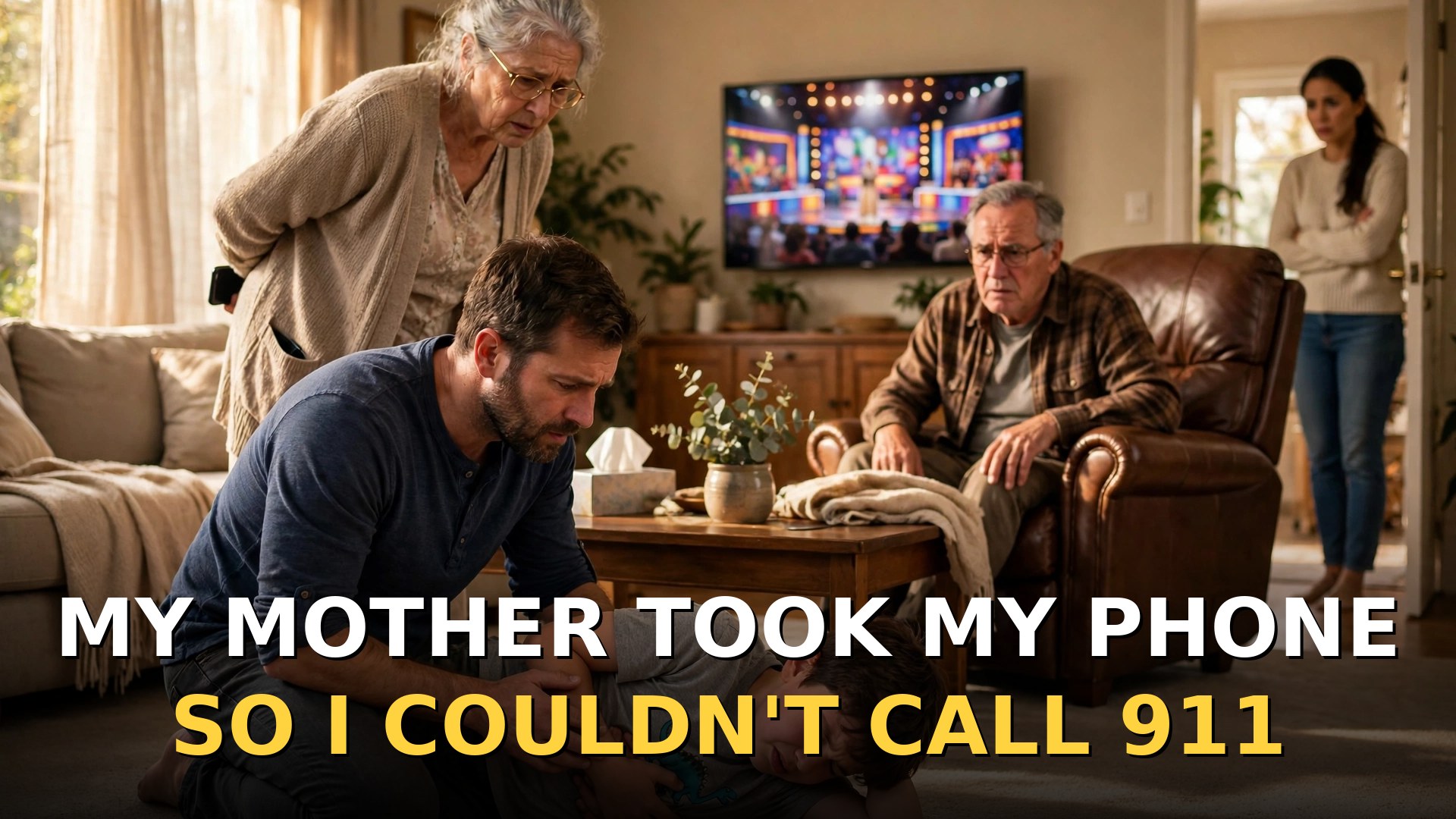
Then she owned the worst of it, the thing I’d seen and hadn’t dared to name. "When Mom took your phone, Mike — I smiled. I stood in that doorway and smiled. Nerves. Habit. Fear. It’s the only face I know how to make when things have to look fine. My nephew was struggling to breathe on the floor and I smiled." Her voice went. "I will never forgive myself for that."
I didn’t give her false comfort. What happened in that living room — and what nearly happened, if an eight-year-old hadn’t been braver than the four adults around him — is not okay, and no amount of either of us saying lovely words will make it okay retroactively. But I told her the other true thing: we were kids in the same house, learning the same rules. I followed them for thirty years too. Just more quietly. With better manners. Eli made me look at it — she was allowed to let him make her look at it too.
Logan, she reported, is seeing a counselor, Ms. Ortiz, twice a week. And he wants to write Eli a letter. Ms. Ortiz’s condition: reading it has to be Eli’s choice. Entirely. I said I’d ask — and that if Eli said no, or not now, there would be no pressure and no guilt, from her or from Logan, ever. She agreed like it cost her, which is how I knew she meant it. Then I told her she needed to talk to someone herself — for Logan’s sake, if she couldn’t do it for her own. She almost laughed. Ms. Webb had already given her a number. Her own appointment is Thursday.
I took my sister’s hand on my porch steps. Not forgiveness. Not yet. The first crack of light in a wall we’d both been living behind since childhood.
That evening, Eli — propped in his dinosaur blanket with a pillow bracing his side — considered the letter question with the gravity of a small judge. Was Logan still sad? Very. Was he still mad? No. Just sorry. Then my son, age eight, made the distinction that three adults in a living room hadn’t managed: "Grandma said boys fight. That wasn’t a fight. A fight is when both people are hitting. Logan was just hitting me, and I didn’t hit back, because that would be wrong. So Grandma was wrong."
"That’s exactly right, buddy. That is exactly, precisely right."
He decided he’d read it. With me. And maybe Mom. And after a cookie first. Terms accepted.
The letter came Monday, on lined notebook paper, in a twelve-year-old’s handwriting that gets shakier toward the end. Logan is sorry. He was angry, but anger isn’t an excuse, and he’s been ashamed every day since. When Eli told him on the stretcher that saying sorry counts, he hadn’t known what to do with that — nobody had ever told him a mistake could be forgiven that easily. And then, in the shakiest writing on the page: You’re braver than me. You pushed your button when everybody told you not to. I should have pushed a button a long time ago, when stuff felt wrong at my house. I didn’t know I was allowed. I’m learning I’m allowed.
Eli studied that last line for a long time. Then he disappeared to his room and came back twenty minutes later with a drawing: two stick figures, one tall, one short, both smiling, standing beside a giant red button with a yellow star on it. Across the bottom, in his best careful letters:
IT’S OKAY TO PUSH THE BUTTON. EVEN WHEN YOU’RE SCARED. ANY TIME.
Signed: Love, Eli. That drawing is framed on my desk today. It will be there when he’s forty.
Three weeks after that Sunday, the county attorney’s decisions came down. Logan: juvenile diversion — counseling, workshops, the written apology, supervised community service, and no formal record if he completes it. Ms. Webb reports he shows up early, does the reading, asks questions. My mother: charged with a misdemeanor for interfering with an emergency call. Given my father’s full, unprompted statement to the prosecutor, and her clean history, the judge chose something unusual — something I think about whenever people say the system only knows how to punish. Diane Donnelly was sentenced to a thirty-six-hour citizen’s emergency-response course spread over ten weeks: how to call for help, how to do first aid on a child, how to recognize a medical emergency. Plus twenty-four hours of community service at the county emergency dispatch center, answering non-emergency lines and shadowing the dispatchers.
"She has to learn to call 911," I said.
"That’s not punishment," Sarah said. "That’s justice. The kind that might actually change something."
And then Ms. Webb told us about a tradition. When a child uses an emergency device correctly and it makes a real difference, the 911 team likes to meet the child — because dispatchers almost never learn how a call ended. Eli set his conditions: no speech, no tie, and snacks guaranteed in writing.
The center is quiet as a library, all low voices and glowing screens. Carol — fifty-eight, twenty-one years on the headset — was the dispatcher who took Eli’s watch call. She explained what she’d received: a signal, a location, a very short message, and through the watch’s little microphone, behind the sound of grown-ups arguing, a very quiet boy, breathing wrong, trying hard not to make noise. "I thought, that child is in trouble and being brave about it," she said. "So I sent everybody we had." Eli admitted he was scared. "You did it scared," Carol said. "In twenty-one years, the bravest sound I know is somebody finding a way to ask for help without letting anyone stop them."
She pinned a small gold pin on his shirt — shaped like a headset, with a blue border — given only, she told him, to people who help the helpers. The entire center stood and applauded, softly, the way people applaud in a library during an earthquake of joy. Eli turned the color of a ripe tomato and asked why. "Because we almost never get to see how the story ends," Carol said. "And you’re the good ending."
Over frosted cookies, my son asked her what happens when somebody calls and nobody helps. Carol didn’t miss a beat. "Then we try to be the somebody," she said. "That’s the whole job."
Eli nodded like a small king ratifying a treaty. "Somebody should be."
There was one person left. One door I hadn’t opened since the ambulance pulled away — and in the third week of November, my mother finally knocked on it herself, with a two-page handwritten letter. What she wrote, and what she did on her knees on our living-room rug, is the end of this story, and it’s waiting on the website.
