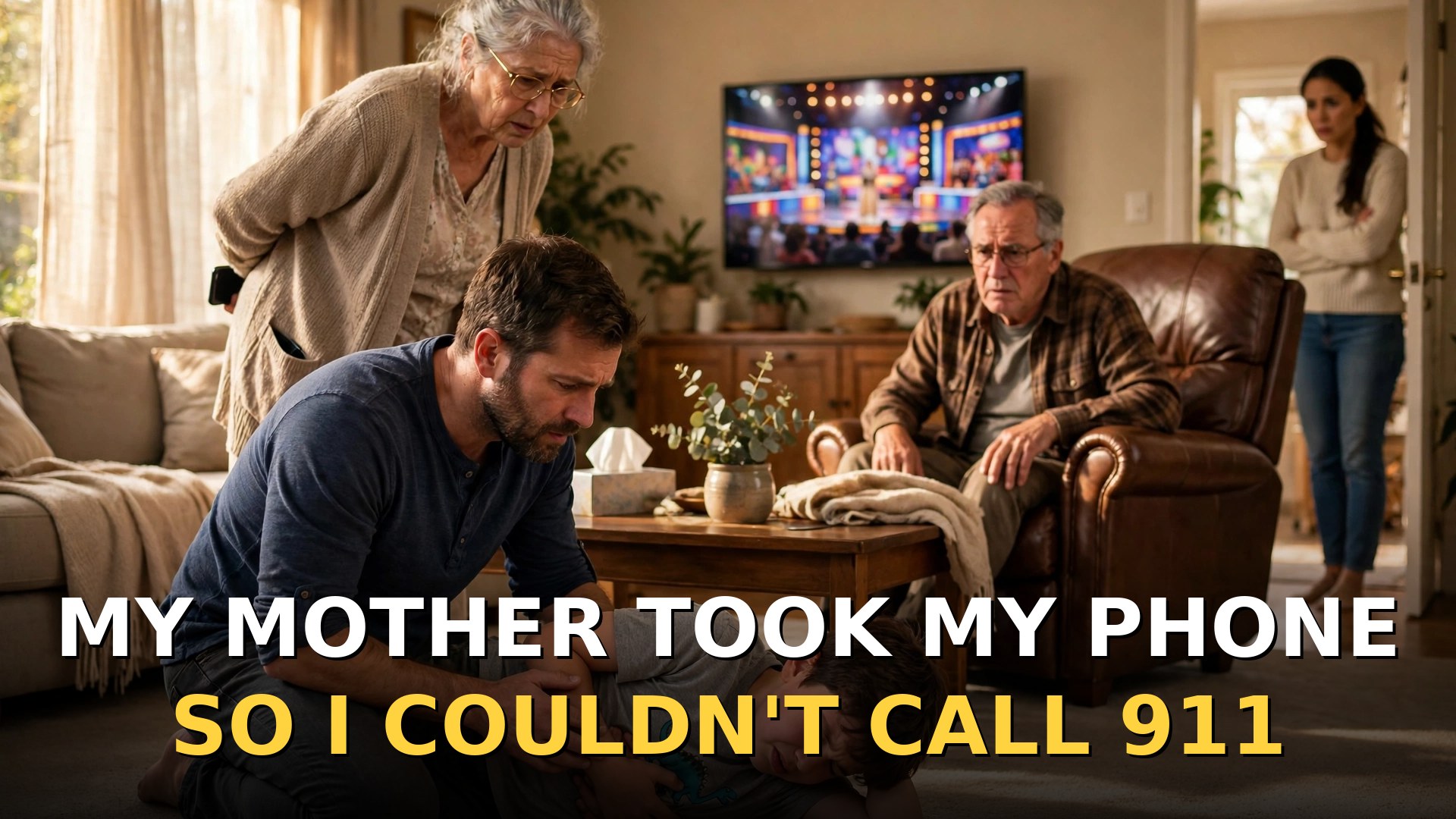
Part 3 — The Lobby at Ten O’Clock
Sarah said it best, that night, the way she says everything: plainly, and once. "Two things are true, Mike. Your mother raised you. And your mother stopped you calling for help while our son couldn’t breathe. You don’t have to decide tonight what to do with both of those. But Eli is never — ever — in a room like that again." I held our sleeping boy’s uninjured side and made a promise into the dark of that hospital room: Never again.
Eli was kept overnight for observation. Around eight, Officer Ruiz came back with Ms. Webb from county family services — there because a twelve-year-old was at the center of this, and a thing like Logan’s doesn’t grow out of nothing. Nobody, she said clearly, was questioning our care of Eli. Then she asked me questions for nearly an hour, under a framed painting of a sailboat, and I did the hardest thing a man from my family can do: I told a stranger the truth about us.
Logan: three schools in four years. Karen: always between apartments, between jobs, always certain someone else was at fault. My parents: always smoothing it over for her — a neighbor’s broken window, a teacher’s note, a fender-bender that "wasn’t really her fault." And growing up in that house, I told Ms. Webb, I never once — not once, in thirty years — heard an adult say the words I was wrong.
Then I told her about the garage roof.
I was ten. Karen was fourteen and in a bad stretch. She dared me up onto the garage roof, and I fell, and my arm broke with a sound I can still hear if the house is quiet. My parents took me to an urgent care on the other side of town, where nobody knew us, and my father told me — in the car, with my arm swelling in my lap — to say I fell off my bike. Because neighbors talk. Because it would hurt the family. What happens in this house stays in this house. I was ten years old and brave and in agony, and I obeyed. I lied to a doctor with my parents standing right there, and they let me.
Ms. Webb named it like a diagnosis: families that protect their image at the cost of the people inside them. Children raised that way learn that speaking up is betrayal. Some of them repeat it. Some of them break it. She told me what Logan had said to Officer Chen: he’d been afraid that if he told the truth, nobody would believe him and his mother would be angry — and that Grandma had taught him for years that some things just go away if everyone agrees on the story.
Logan’s likely path, in this county, at twelve: juvenile diversion. Counseling. Accountability. A written apology. A chance to make it right — if he takes it. My mother’s path was separate, and more serious: interfering with an emergency call. The county attorney would review everything Ruiz had witnessed and written down.
I signed my statement. One of the hardest signatures of my life — and my hand shook not from fear, but from stepping off a ledge I’d been standing on since I was ten years old in the back of a car, learning to lie.
My phone, restored to me, showed thirty-seven missed calls and nineteen texts by the time Eli slept. Mostly my mother: call me right now. Your father hasn’t eaten. You are tearing this family apart. They’re treating Logan like a criminal. Are you happy? A few from Karen. And one from a number I didn’t know.
Sarah turned the phone face-down on the tray table. "Not tonight," she said.
The unknown text was from my father’s landline. My father, Frank Donnelly, seventy years old, has never texted anyone. He can barely operate the landline; he must have typed it letter by letter like a man defusing something. I’m in the lobby downstairs. I don’t want to argue. I only want to see Eli, if I’m allowed. If not, I understand. I’ll wait as long as you want me to.
He had come alone. He had not brought her.
At ten o’clock I went down to that nearly empty lobby, and my father stood up too fast and had to steady himself on a chair, and I almost didn’t know him: shoulders rounded, same clothes from the afternoon with a coffee stain down the front, a big man made small. He asked how Eli was and I told him — broken rib, clean break, lung fine, overnight — and he closed his eyes and thanked God out loud, in public, which Frank Donnelly has never done about anything.
Then he told me what he had done, which was nothing, in detail. After the ambulance left, my mother and Karen stayed inside going over what everyone would say. He sat on the porch step and could not get up. Because right before he turned the television down — right before — Eli had looked at him. Directly at him, from the floor. And Frank had looked away, and picked up his drink.
"I spent my whole life telling myself keeping the peace was the same as being a good man," my father said. "Today I sat in a chair and let a child gasp on my carpet because I couldn’t stand the thought of police cars at my door." Then he said the thing that connected the two worst afternoons of my life. "You asked me the same question at ten, Mike. Holding your arm. Are you mad at me? And I told you to lie about the bike. I taught you that family comes before truth. Before yourself. I taught it to Logan today too. And I’d have taught it to Eli — if Eli hadn’t been braver than every one of us."
My father did not cry at his own father’s funeral. He cried in that lobby until a nurse brought him water in a paper cup.
I sat down beside him. I told him I wasn’t ready to forgive him, and I didn’t know when I would be, and he nodded like a man accepting weather. I told him I was glad he came. And I was glad — this mattered, though I couldn’t have said why then — that he hadn’t brought her. Then I gave him the new rule, the first of many: he could look at Eli through the door glass. And if Eli woke, and wanted to see him, that was Eli’s choice. Not his. Not mine. Eli’s.
He stood at that glass for nearly ten minutes. And Eli woke. And saw him. And gave a tiny, uncertain wave.
My father pressed his whole palm flat to the glass and mouthed I’m sorry at his grandson.
Eli held up his wrist, and tapped his watch twice, and gave him a thumbs-up.
He told Sarah later he just wanted Grandpa to know he wasn’t mad, and the watch was okay. But I know what I saw through that door, and I’ll keep it the rest of my life: I see you. You’re trying. We’re still here.
