Part 5 — Mostly Not Mad
The letter sat unopened on our kitchen counter for two days. I kept picking it up and putting it down, the way you handle something that might be hot. When I finally opened it, the first line stopped me in the middle of my own kitchen.
I was wrong.
The first time in my life my mother has ever begun anything with those words. Wrong that day, she wrote, and wrong for a very long time. She described her course: six weeks of Saturdays left to go, in a classroom with fourteen strangers, learning how to help a child who cannot breathe. When the instructor asked why she’d come, she told the whole room the truth — that she had once stopped someone from calling for help for her own grandson. And instead of disgust, a woman named Ruth, seventy-six, whose husband has a heart condition, had reached over and taken her hand and said that saying it out loud was courage.
She wrote that she had believed her whole life that love meant holding the family together: shut the door, keep the secrets, keep it smooth. It wasn’t love, she wrote. It was fear. Fear of what people would say. Fear of losing the thing she’d built. Fear of seeing the cracks. And in that fear she hurt her grandson, and hurt me, and hurt the ten-year-old boy I used to be — the one with the broken arm, told to lie about a bicycle, whose memory she’d pushed down for thirty years.
She didn’t ask me to forgive her. She asked for one thing: a chance to say to Eli, in person, if he allowed it, what she should have said that day on the carpet.
I judged it a beginning. And enough for a beginning.
We set the terms, and they were ours: a Sunday afternoon, at our house. Tea and cookies. Eli’s ribs healed. Eli wearing his gold pin. I told him beforehand, on his bed, with the dinosaur blanket: you do not have to say anything, hug anybody, or forgive anybody today. Whatever you feel is what’s true. He said he’d listen first.
She arrived at two with my father. Smaller. A plain blue sweater, no jewelry, hands trembling, carrying a small paper bag. Eli greeted her at the door, solemn as a mayor. She broke down before she got her coat off. Eli, very practical, pointed out that she’d learned to call 911 now. She laughed shakily: she’d also learned to check breathing, and keep a hurt person still, and stay on the line until help comes — she’d practiced on a dummy named Freddie.
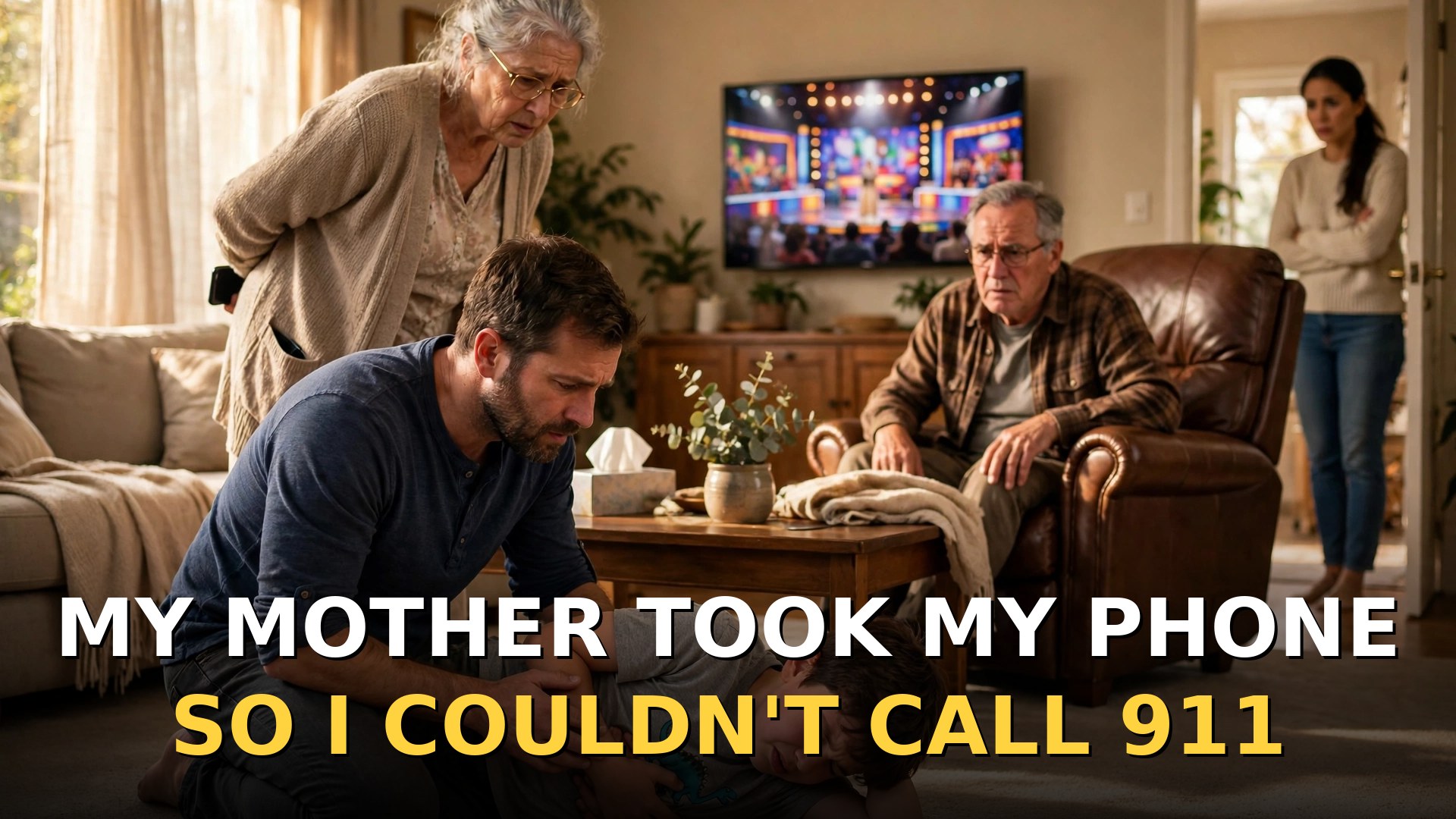
Then my mother — Diane Donnelly, who has not knelt for anything but gardening and church in forty years — slid off our couch and got down on her knees on our living-room rug, so she could be at my son’s eye level, and she apologized the way apologies are supposed to be done and almost never are. Specifically. She took his father’s phone and wouldn’t give it back. She told everyone Eli had started a fight when he had not. She said things that were not true. She was scared and ashamed and she let those feelings matter more than him, and it was wrong, and it was never, ever his fault. She was sorry she hadn’t helped him. Sorry that he had to be brave when she should have been brave for him.
Eli asked if she was scared. She whispered that she was. So scared.
"I was too," Eli said. "But I pushed the button anyway. Next time, maybe you can push it."
"I will," she said. "I promise you. I will."
He stepped toward her carefully — the way a person tests ice — and hugged her around the neck. She held him like he was made of blown glass. And over her shoulder, muffled into her sweater, my son delivered his verdict: "I’m not all the way not mad. But I’m mostly not mad."
She laughed and cried at the same time. "That," she said, "is the most generous thing anyone has ever said to me."
Then she opened the paper bag. Inside was a brand-new smartwatch — dark blue, sized for a young wrist — because his old one was scratched and its screen wasn’t right. She’d had the store clerk show her, twice, how to set up the emergency feature, so she’d know how it works before she ever had to. Eli said he’d keep the first watch too. He thanked her for the new one. And then he asked her to help him put it on — and to show him that she knew the button.
Her hands shook. She fastened the strap. And grandmother and grandson bent their heads together over that tiny glowing screen while he showed her, and she showed him back: hold for three seconds. Even if grown-ups tell you not to.
"Even me," she said quietly. "Especially me."
That is what a pattern breaking looks like. Not a shout. Not a scene. A quiet lesson on a living-room rug, given by the smallest person in the room to the people who should have taught him.
Spring came slowly to Maple Court. The cherry tree in our front yard went thick and pink in April. Eli’s ribs were a story he told at recess for applause. He played Saturday soccer like the whole thing had been a rumor.
Change came the way change actually comes: in fits, in starts, in small unglamorous choices. My father started coming to soccer games — far end of the bleachers, folding chair, blanket, never cheering too loud — and Eli looked for him every single game, and waved. Karen and Logan moved to a small apartment across town, nearer his new school. Karen got a job as a receptionist at a pediatric clinic and kept it past six months — the first time in years — kept every Thursday therapy appointment, and started calling me on Sundays. Awkward, at first. Then easier. Sometimes about nothing at all. "I keep waiting to feel like a different person," she told me once, "and then I realize I am one. It’s just happening one small choice at a time."
Logan finished his diversion in April, three weeks ahead of schedule. He keeps Eli’s red-button drawing taped inside his school locker, for hard days — a reminder that he’s allowed to ask for help. The rebuilding between the cousins went the way it should: supervised, gradual, earned. A park walk with both mothers close. Pizza. A bowling afternoon where Logan lost so spectacularly that Eli laughed until he had to sit down — and then grinned up at him and said, "Good game." Logan stopped. His whole face changed. And he grinned back, and said it back, and Sarah, standing beside me, whispered: "He said that the day it happened. Logan couldn’t hear it then. He can hear it now."
At the end of April, the whole family came to dinner at our house — by choice. Not obligation. Not image. Choice. My parents brought a lemon pie my mother had baked from scratch that could take the enamel off a spoon, it was that tart, and she was prouder of it than of any smooth thing she’d ever served. Karen and Logan brought garlic bread and sparkling cider. Sarah made lasagna. We are not a perfect family now, and this story doesn’t end with us becoming one. My mother still goes red saying the word sorry. My father still falls silent when talk gets hard — though now he catches himself, clears his throat, and says, "I’m trying to say something," and then, haltingly, does. Karen still bristles at criticism. I still feel the old reflex rise in me to smooth things over, and I have to breathe through it, every time.
But we’re trying. Honestly trying. And that turns out to be the whole difference.
Before we sat down, Eli tapped his fork against his water glass until the room quieted, and announced that he had made a rule, and he unfolded a sheet of construction paper covered in glitter and stars. At the top, in his best letters: THE DONNELLY FAMILY RULE. And he read it aloud, standing on a chair, in the voice of a boy addressing a nation:
One. If someone is hurt, we call for help first. Two. We tell the truth, even when it’s hard. Three. Nobody has to keep a secret that makes them feel scared or sick. Four. It is always okay to push the button.
"Do you all agree?" he demanded. My father spoke first, his voice thick: "I agree." Then my mother, quietly: "I agree." Then Karen. Then Logan — who counted on his fingers and said, "Five — I mean four — I mean I agree," and the whole table cracked open laughing, and the room went loose and warm. Then Sarah. Then me. All four rules. Every one.
That night after dishes, I found Eli in his pajamas, in bed, holding his old scratched watch in both hands while the new one charged on the nightstand. He told me the thing he remembers clearest about that day isn’t the floor or the pain. It’s looking at me, and me looking back, and knowing that I knew. "I only had to nod," he said. "And you understood. It worked because you taught me. And I trusted you."
I told him my side of the inheritance, the lesson I want him to carry into rooms I will never see. "You are going to be in a lot of rooms in your life, buddy. Happy ones and hard ones. And in some of them, everybody is going to tell you: don’t say anything. Don’t make trouble. Keep the peace. It will feel like the whole world is asking you to be quiet. Your grandma asked. Your grandpa asked. And I did it, when I was ten — I broke my arm, and I was told to lie, and I lied, and I was ashamed about it for a long, long time. You did something better than your dad. I taught you the button. But you taught me: the bravest thing a person can do is refuse to be silent."
"We’re a team," Eli concluded. "You, me, and Mom. And Grandma and Grandpa. And Aunt Karen and Logan. Everybody who’s trying." A pause. "And Freddie the dummy."
I laughed so hard I had to cover my mouth in his dark doorway. Then my son told me he was really glad I was his dad, and I told him I was really glad he was my son, and I kissed his forehead and turned off the lamp, and left his two watches glowing side by side on the nightstand — one scratched, one new. Both his. Both working.
In the kitchen, Sarah was drying the last of the plates, and she just put her arms around me and we stood there a minute — our boy okay, us okay — while outside the window over the sink, the cherry tree shook loose a whole cloud of pink petals into the warm spring dark.
I wrote all this down because I keep coming back to those eleven minutes on the timer. That’s how long a child waited on his grandparents’ carpet for help to arrive — and in the end, the person who got it for him was eight years old. I don’t tell it to punish my family. My mother now teaches a first-aid class at her church, and opens every single session by telling a room of strangers that she once stopped someone from calling for help — and why they must never, ever do what she did. My father has a new Sunday ritual: he calls Eli every week and asks, "Did you tell the truth this week, even when it was hard?" — and they talk about it, however long it takes. A year on, Logan is thirteen, plays saxophone in the school band, volunteers weekends at the youth center, and wants to be a paramedic when he grows up — because of Eli, he says, grinning, and because, as Carol the dispatcher said, somebody should be. Eli is nine. The gold pin sits in a shadow box on his shelf, beside a copy of the red-button drawing, beside a photograph of all of us squeezed around that table in April, laughing — my mother holding up her terrible tart lemon pie like a trophy.
So if you are reading this in a room where somebody is telling you to stay quiet — to keep the peace, to protect a reputation, to honor a family that is not honoring you — hear it from a man who obeyed that room for thirty years:
Speaking up will not ruin everything. Silence is what ruins things. Truth, spoken with love, is what heals them. A small red button and three seconds of courage changed my entire family. If someone you love is hurt and everyone around you says don’t make a scene — make the scene. Make the biggest, clearest, most necessary scene of your life. Call for help first. Ask questions later.
Somebody will come. They always do. THE END
