Eleven Minutes on the Carpet
Part 1 — The Phone Behind Her Back
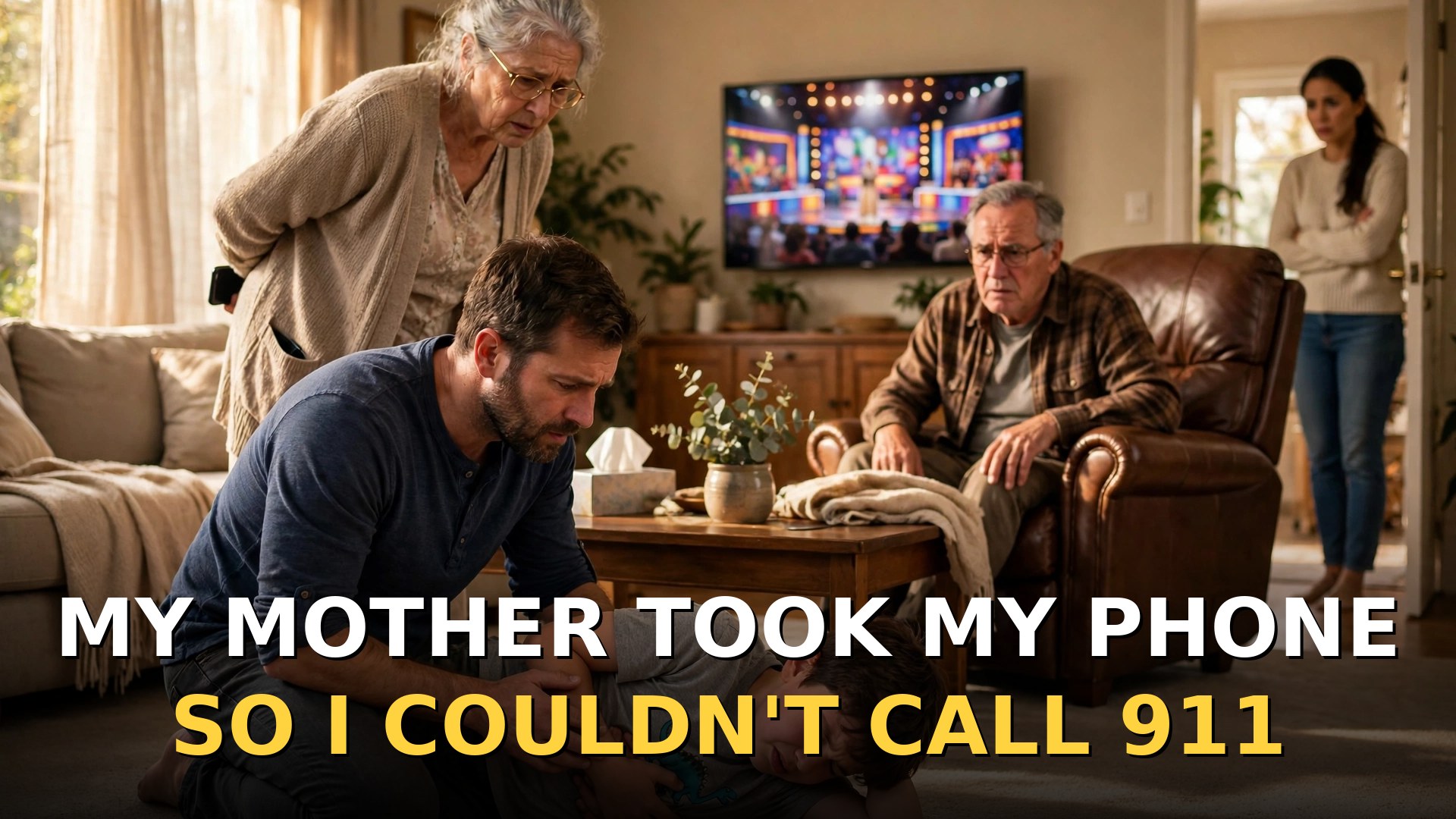
My son lay gasping on my parents’ carpet, and my mother hid my phone behind her back so I couldn’t call for help.
Read that again. I have. About ten thousand times.
Eli is eight years old. Third grade. Glasses, a missing front tooth, a best friend named Marcus, and a scratched-up kid’s smartwatch I set up the month he started walking home from the bus stop with a friend — because I am the kind of father who lies awake inventing emergencies, and then prepares for them.
That Sunday we were at my parents’ house, like a hundred Sundays. Burnt coffee and lemon cleaner. A game show chattering on the TV. And then my sister Karen came down the hall at a pace that wasn’t running only because Karen never runs, and said, "The boys were fighting."
Eli was on the beige carpet in the living room, one hand pressed to his left side, his face pale around the mouth in a way I hope you never see on a child you love. Every breath he took came out short and ended in a sound like something tearing. His glasses were crooked. One sneaker had come half off. He whispered it before I even got my knees under me:
"Dad. It hurts to breathe."
I had my phone out before he finished the sentence.
My mother stepped in front of me — Diane Donnelly, sixty-seven years old, who packed my lunches for twelve years and taught me to ride a bike in this very driveway — and she took my phone out of my hand. Not grabbed it off a table. Took it out of my hand, and tucked it behind her hip, and said, "Boys fight, Michael. If you call the police on a twelve-year-old boy, you will ruin Logan’s whole future. Is that what you want? To ruin your nephew’s life over a scuffle?"
My father, in his recliner, lowered the television by one click and said I was overreacting.
My sister leaned in the doorway with her arms crossed and a smile on her face — a smile, over my son on the floor — and said, "Eli started it. Ask anybody. Eli started it, and Logan finished it, and now he’s playing it up."
Eli shook his head, once. The pain stopped him mid-shake.
I got down on the carpet and held my son still — you don’t move a child who might have something broken, and some deep paramedic-corridor part of my brain from a first-aid course years ago kept my hands steady — and I coached him the way you coach a kid through a nightmare. Small breaths. I’m here. Small breaths, buddy. When I stood up and reached for the landline on the side table, my mother moved — sixty-seven years old, bad hip and all — and put her body between me and the phone.
So there we all were. My son. My mother, with my phone behind her back. My father, picking up his iced tea. My sister, smiling. And on the television, at full game-show volume, a contestant won a trip to Hawaii, to applause.
That’s the moment I saw it.
A red flash, under Eli’s sleeve. His little scratched watch screen, lit up red, with an SOS symbol blinking over a timer that was counting: 11:07. 11:08. 11:09.
Eleven minutes. My eight-year-old, lying on his grandmother’s carpet with a fractured rib, had pressed and held his emergency button — the one I’d taught him to hold for three seconds — and kept his hand down inside his sleeve, quiet, so nobody would notice and stop him. While the grown-ups in the room argued about what people might say.
Our eyes met over the room full of adults. And my son gave me the smallest nod I have ever seen.
I stopped asking for my phone.
My mother read my quiet as surrender. "You see?" she said to the room. "He understands now." My father set my phone down beside his recliner, out of reach, like a man settling a matter. Karen said nobody here needed police.
Then, from outside: tires on gravel. A car door. Another. And a wash of blue light rolling across the framed school photos above the couch.
My mother snatched my phone up and thrust it onto the end table — "Nobody says one word until we all agree on what happened here" — and there came a knock on the door that I have heard in dreams since. Hard. Official. The knock of people who do not require a family’s permission.
The first officer took one look at my son and called the paramedics forward over his shoulder. His partner went past us down the hall. My mother followed him, talking fast — boys, misunderstanding, family, fine five minutes ago — and the first officer held up a hand, and asked Eli, very gently, to show him the watch. Eli lifted his trembling wrist without pulling at his side. Dispatch crackled back over the radio: child-initiated SOS, location matched to this address.
My mother stopped talking mid-sentence, like a song cut off.
Then the younger officer brought Logan in from the back hallway — Logan, twelve, shoulders curled into his gray sweatshirt, gone a color I’d never seen on him — and asked him, before Karen could reach him, one question. "Did Eli hit you first?"
Logan looked at his mother. He looked at his grandmother. He looked down at his cousin on the floor.
"No," he said.
And then Eli spoke, from the carpet, in a voice so thin it rearranged the furniture in my chest:
"Grandma took Dad’s phone. So he couldn’t call."
What my nephew said next — when they gave him the chance to tell the truth — broke the rule my family had lived by for thirty years.
