
Chapter 1
My own mother looked straight at the jury and said I had never served in the United States Army. She pointed toward the scars hidden beneath my blouse and told a packed courtroom they were fake. Then I looked at the clock above the judge’s head—11:47 a.m.—because there was one thing my mother and brother didn’t know.
“My daughter invented all of it,” Evelyn Cross said under oath. “The deployments, the medals, the combat stories. Everything.” A whisper moved through the courtroom, and several jurors looked at me as if they had already decided what kind of woman I was. I folded my hands on the table because anger was exactly what my younger brother Ryan wanted to see.
Ryan sat across the aisle beside his attorney, pretending to study a stack of papers. I saw the tiny smile he tried to hide when our mother called my Purple Heart something I had probably bought online. For months, he had built a public story in which I was a fraud who had fooled our dying father. If the jury believed that story, I could lose far more than my reputation.
This had started with my father’s company, Cross Meridian Systems, a defense technology firm he had spent most of his life building. Before he died, Dad transferred controlling shares to me and named me executor of his estate. Three days after his funeral, Ryan produced a new will that supposedly gave nearly everything to him. When I challenged it, he stopped fighting over paperwork and started attacking my entire life.
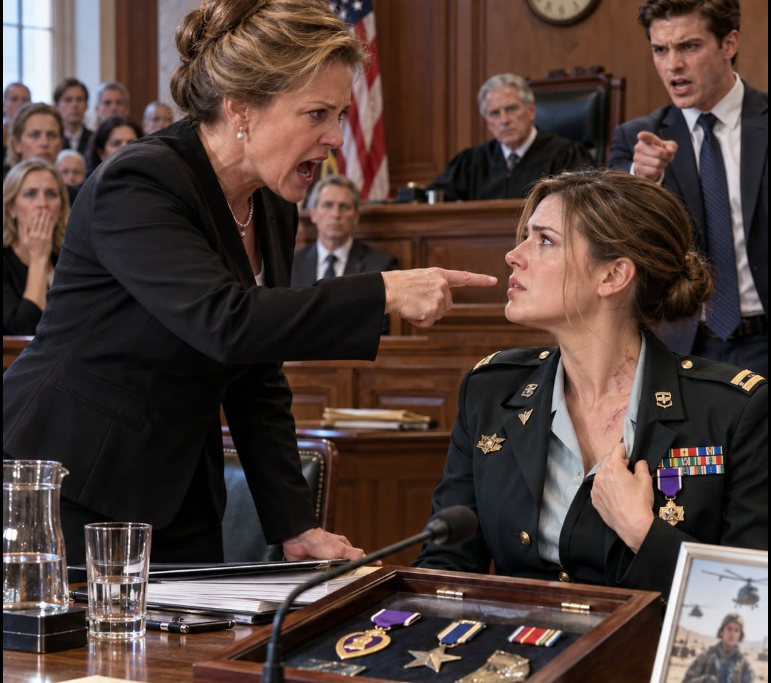
Ryan claimed I had invented twelve years of military service to make Dad trust me. He said I had fabricated combat experience, bought decorations online, and used a false identity to manipulate our father into giving me control of the company. Then he alleged that some of my military documents were forged federal records. Once prosecutors became involved, a family inheritance battle turned into a criminal case.
The problem was that Ryan had chosen his accusation very carefully. I really had served twelve years, but much of what I had done was tied to assignments that ordinary public records could not fully explain. Some award citations were restricted, some assignment details were sealed, and one operation connected to my injuries remained classified. I could tell the court I was innocent, but I could not simply reveal everything needed to prove why.
That silence made me look guilty.
The prosecutor lifted the wooden shadow box my father had made before cancer took the strength from his hands. Inside were my Silver Star, my Purple Heart, and a burned piece of the unit patch that had been cut from my uniform after a mission that nearly killed me. My mother stared at it without emotion. “She purchased those online,” she said.
The scar along my ribs began to ache as if my body remembered before my mind did. For one second I was no longer sitting beneath courtroom lights; I was hearing helicopter blades, smelling smoke, and tasting blood. I remembered Major Ethan Walker dragging me through burning wreckage while rounds snapped somewhere beyond the flames. I remembered waking days later unable to understand why I was still alive.
None of that was fake.
But Ethan could not simply walk into court and say so. Neither could the people whose names remained protected, and neither could I expose a classified operation just because my brother had discovered how useful my silence could be. Ryan understood that limitation. That was what frightened me most.
Before my father died, he had given me another reason to be cautious. One night in his hospital room, when his voice was barely stronger than a whisper, he held my hand and told me money was moving out of Cross Meridian through shell companies. “Protect the company,” he said. Then he squeezed my fingers and added, “But don’t expose your unit.”
I promised him.
After his death, I began reviewing company transactions while Ryan fought for control. Payments had moved through consulting firms and companies that seemed to exist mostly on paper, and several had connections to Ryan’s side of the business. I did not yet have enough to accuse him of everything I suspected. What I did know was that if he could destroy Dad’s trust in me, he might destroy my authority to keep investigating.
That was why the military fraud story mattered so much.
My father’s longtime attorney stood to question my mother. “Mrs. Cross, did your husband believe Claire served in the Army?” he asked. Mom tried to avoid the answer by saying Dad had been very sick near the end. When the judge ordered her to respond, she finally admitted, “He believed her.”
“And he trusted her enough to transfer controlling shares of Cross Meridian Systems to her?” the attorney asked.
—END OF Chapter 1, —PRESS NEXT PART IN BOTTOM OF PAGE TO READ NEXT Chapter
READ ENDING HERE ⤵️👇
