PART 5:
Judge Hanley set his notes on the bench and looked out over the courtroom the way a man looks at a house he has finally finished repairing. He did not raise his voice. He did not need to. Every person in that room had already learned, over the last two hearings, that his quiet was more dangerous than anyone’s shouting.
“I have presided over family court for nineteen years,” he said, “and I have rarely seen a case where the medical record and the courtroom record told two such different stories. That gap did not happen by accident. It happened because someone chose, more than once, to show me only the parts of the truth that served them.”
Daniel’s attorney started to rise. Judge Hanley did not even look at him.
“Sit down, counsel. You will have your turn, but I am speaking now.”
He turned a page, though I suspected he already knew every word on it. “In May, a physician recommended cardiac monitoring for this mother after repeated episodes of near-fainting. That recommendation was known to the father. It was known to his attorney. Neither of them disclosed it to this court. Instead, this court was told, repeatedly, that there was no medical basis for the mother’s symptoms, and that her collapses, her dizziness, and her exhaustion were forms of manipulation designed to gain advantage in a custody dispute.”
He looked at Daniel now. Daniel did not look back.
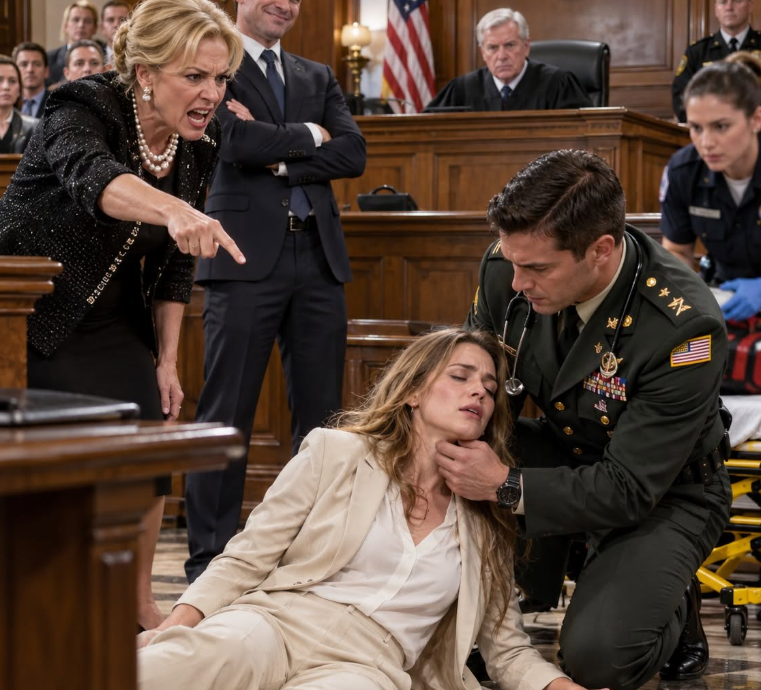
“Three weeks ago, in this very courtroom, this mother’s heart rate dropped to thirty-six beats per minute in front of everyone present. A military physician who had never met her before that morning recognized a medical emergency within seconds. The people who had known her for years, who had shared a home and a marriage and a child with her, called it a performance. I do not say this to humiliate anyone. I say it because it is the single most important fact in this case, and I intend to treat it that way.”
I felt Colonel Carter shift slightly in the gallery behind me, not moving, just present. I did not turn around. I kept my eyes on the judge, because for the first time in this entire ordeal, I was not the one who needed to prove anything in this moment. I only needed to listen.
“I want to be clear about something,” Judge Hanley continued. “Custody decisions are not punishments. I am not interested in deciding who was crueler, or who said the worse thing, or who deserves to suffer for what happened in this courtroom. I am interested in one question only: what arrangement allows this child, Lily, to grow up safe, loved, and free from the burden of managing the conflict between her parents.”
He set the pages down.
“The guardian ad litem’s report makes it clear that Lily loves her father. It also makes it clear that Lily has been placed, repeatedly, in the position of evaluating her mother’s medical credibility — a task no seven-year-old should ever be asked to perform. She has heard herself, apparently more than once, that her mother ‘gets sick when she wants attention.’ I do not know whether that sentence was said maliciously or carelessly. I only know that a child should never hear it about her own parent.”
Patricia’s chin lifted slightly, the way it always did when she was preparing to disagree with something. But she stayed silent. She had learned, finally, that this was not a room where her certainty carried weight anymore.
“Effective today,” the judge said, “primary physical custody of Lily will remain with the mother. The father will retain regular, structured visitation, because I have no evidence before me that he poses a danger to his daughter’s physical safety, and I will not sever a relationship a child clearly values without cause. However, that visitation will be supervised for a period of ninety days, not because of any single act of violence, but because both the father and the paternal grandmother have demonstrated, in this courtroom and apparently in front of the child, an inability to separate their anger at the mother from their responsibility to protect Lily from that anger.”
Daniel’s jaw tightened. I watched the muscle move along the side of his face, the same tell I had learned to read across nine years of marriage.
“The paternal grandmother,” Judge Hanley continued, and this time his eyes moved to Patricia directly, “will have no unsupervised contact with the child until she completes a course in coparenting communication approved by this court, and until Ms. Bell confirms that Lily is no longer repeating statements that frame her mother’s illness as fabricated. I want to be plain about why. A grandmother is allowed to disagree with her son’s ex-wife. She is not allowed to teach a seven-year-old to distrust her own mother’s body.”
—END OF Chapter 3, —PRESS NEXT PART IN BOTTOM OF PAGE TO READ NEXT Chapter
Categories Stories USA
© 2026 Dacsanhht.com | All Rights Reserved.
READ ENDING HERE ⤵️👇
