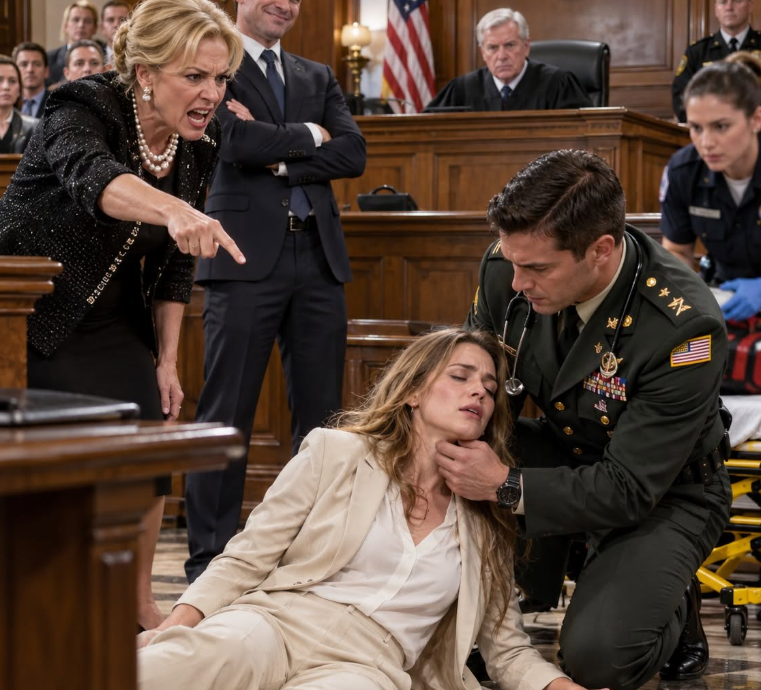
PART 3:
The pacemaker left a small scar below my collarbone, but the strangest thing happened the morning after the procedure. I stood beside the hospital bed expecting the room to darken the way it always did, yet nothing happened. I took ten slow steps down the hallway without grabbing a wall or waiting for my hearing to fade. I started crying simply because I was standing upright and my body was finally staying with me.
Daniel came to the hospital that afternoon. He looked at the bandage and actually asked, “You really got one?” as if there were still a chance the whole thing had been theater. When I reminded him that he had testified there was nothing seriously wrong with me, he said he had only believed what the earlier tests showed. Then I asked him about the doctor who recommended cardiac monitoring in May.
For one second, his eyes shifted away from mine. He said he did not remember the conversation, but when I repeated the doctor’s warning about an intermittent rhythm problem, Daniel replied, “Doctors write things like that to protect themselves.” The answer came too fast. He might not have known my final diagnosis, but he clearly remembered that someone had warned us there could be a physical problem.
That was the moment my anger changed. I had spent months wondering whether Daniel truly believed I was imagining everything or whether he had simply found that explanation convenient. Now I knew he had heard at least one doctor say more testing was needed, yet he still sat in court while his attorney described my symptoms as proof of instability. I stopped trying to make him admit what he had done and started preparing to prove what had happened.
The court appointed a guardian ad litem named Susan Bell to look after Lily’s interests. Susan met with me, Daniel, and Lily separately, and she made it clear that her job was not to decide who had been the better spouse. She wanted to know how the conflict was affecting our seven-year-old daughter. That frightened me more than any medical test.
When Susan later called, she told me Lily had been exposed to adult conversations about whether my illness was real. I felt sick all over again. Lily had apparently heard people discussing my dizziness, my hospital visits, and whether I was pretending. Susan would not give me every detail over the phone, but she said one thing that stayed with me: “Lily should never be placed in the position of evaluating whether your medical condition is real.”
The report arrived the next morning. Lily loved her father, enjoyed spending time with him, and was not claiming he physically hurt her. But she was anxious about transitions, felt pressure when she missed me, and believed she was supposed to notice whether I looked tired or sick. The conflict between Daniel and me had started becoming a job our child thought she had to manage.
Then I reached the sentence that made my hands go cold. Lily had told Susan, “Grandma says Mommy gets sick when she wants people to feel sorry for her.” Patricia had not limited her contempt to the courtroom. She had carried it into my daughter’s world.
I looked through the doorway at Lily sitting on the couch with her plastic dinosaurs spread around her. She was seven years old, still slept with the same stuffed rabbit she had loved for years, and should never have been asked to decide which adults were telling the truth. That night I made a decision that changed the way I approached the case. I would not ask the court to destroy Lily’s relationship with her father; I would ask the court to stop adults from making her choose sides.
I built a timeline using only facts. Emergency room visit, recommendation for heart monitoring, blackout, another medical visit, Daniel’s custody filing calling my symptoms psychosomatic, courtroom collapse, pulse in the thirties, telemetry findings, pacemaker. When I saw everything arranged by date, I understood how dangerous the missing pieces had been. My story had never been empty—it had been edited.
The next hearing was set for October 3. The night before, Lily climbed onto my bed and asked whether I was going to fall down in court again. I told her I did not think so, because now the doctors knew what was wrong and I knew what to do if I felt sick. Then she leaned against me and whispered, “I knew you weren’t pretending.”
I held her tightly and told her she never had to prove that to anyone. After she went to sleep, I sat at the kitchen table with five folders in front of me: medical records, financial records, custody documents, saved messages, and my timeline. The first time I went to court, I had tried to convince everyone I was a good person. This time I was bringing facts they could not dismiss.
READ ENDING HERE ⤵️👇
